My “Christmas In The Heart” CD and Christmas cards. Photo by Peter Skiera.
This is my third-year presenting “Have A Strange Christmas”, where I take a deep dive into strange Christmas records. This holiday, I decided to do something a little different. Rather than cram 5 albums into one very lengthy article, I’ll be posting one strange Christmas record each week starting this week through and including the last week of December. I kick off my series with none other than Bob Dylan.
I recall reading a story about John Lennon playing a Bob Dylan record for Paul McCartney. I think it was around the time The Beatles were recording their Rubber Soul album. McCartney said he didn’t like Dylan’s voice, to which Lennon responded, “Listen to the words, man.” Dylan’s unquestionably a very gifted songwriter, but I’ve never been able to completely get past his whining, gravelly voice. His Christmas album is no exception. Yes, Bob Dylan recorded a Christmas album.
Deep Throat
Dylan’s voice is about as far afield from Bing Crosby and Perry Como as it can get, but that didn’t stop him from belting out an entire album’s worth of Christmas songs in October of 2009. Besides his voice sounding like it’s been roasting on an open fire, Robert Allen Zimmerman was born and raised Jewish, although he later converted to Christianity and changed his name. Dylan said everyone can relate to Christmas music regardless of religion. I agree with him on that score, although I find it difficult to relate to most of the songs on Christmas In The Heart (Columbia 88697 57323 1).
Perhaps if Dylan had used his God-given songwriting talent to write some brilliant Christmas songs of his own for this album, that might have rescued it. After all, we’re talking about the winner of the 2016 Nobel Prize for Literature. Instead, what we have here are 15 Christmas classic covers in two nostril, throat-sonic sound. So much so, I think it should’ve been called “Christmas In The Throat”.
The three wise men escaping the “Christmas In The Heart” release party.
Kleenex Says Bless You
Diving into the songs on Christmas In The Heart, sixteen seconds into the first song, Here Comes Santa Claus, it sounds like Dylan’s voice cracks. Other than that, the song is actually pretty good, as is Winter Wonderland. I’d also put Little Drummer Boy in the same category. Must Be Santa is a hoot and is the unquestionable standout track. The rest of the songs on the album, however, are enough to reduce the baby Jesus to tears.
My blurry pics of Bob Dylan on stage and my original ticket stub from 1996. Photos by Peter Skiera.
Dark And Blurry
To those Dylan devotees who feel I’m being too hard on him, I liked him when he was a Traveling Wilbury, and I’ve already acknowledged that I think Dylan is a songwriting genius. Which is why, 27 years ago, I went to see him perform live in Portland, ME. I sneaked in my Minolta 35mm SLR camera and managed to get some snaps from the mezzanine. Dylan was wearing a very unusual shiny silver jacket that looked like it had a million tiny mirrors sewn on it. “Recording devices” weren’t allowed but I had no idea cameras fell into that category. Security staff were going through the audience literally ripping the film out of people’s cameras (this was before there were digital cameras and smartphones). That’s why my photos came out dark and blurry because I was clicking quickly while trying my best to conceal my camera. I also had the flash turned off so it didn’t give me away.
My opinion of Heart must be in the minority because the record opened at #1 on the Billboard Holiday chart, reached #5 on the Folk chart, made it to #10 on the Rock chart, and peaked at #23 on the overall album chart. It would seem music lovers across the board loved this record.
Laughing All the Way
Indeed, on Amazon, 82% of the reviews are 4 stars or above. Yet I found comments that were more along the lines of what I was thinking: “…it’s almost painful to listen to him try to sing. This may be the worst Christmas album I’ve ever heard”; “You have to LOVE Dylan and/or have a fantastic sense of humor”; “It’s like sticking a large bore needle into your ear into your brain”; “Awful. Sounds like my cat in heat…”; “A strange take on many classic songs and it reminds me of being at a Christmas party where everyone has had a few and someone brings out a guitar.”
The hype sticker on the front of my Christmas In The Heart CD mentioning Feeding America. Photo by Peter Skiera.
The Season of Giving
In light of its success, Dylan must have made a bundle off of this album, right? Wrong. Not that he needed the money, mind you. To his great credit, all proceeds went to charity. In the US, Feeding America benefited, while in the UK it was Crisis, with the rest going to the World Food Programme. Strange as it may be, Christmas In The Heart fed a lot of hungry people in the world.
Stocking stuffer: Mrs. Claus is looking pretty good for her age. Illustration by Olivia De Berardinis.
All I Want For Christmas Is You
One thing I do love about Christmas In The Heart is its visual presentation. The front cover artwork of a horse driven sleigh taken from an antique print reminds me of Christmas albums gone by. Inside the CD booklet is a great color illustration of Bettie Page as a sexy Mrs. Claus. If Mrs. Claus looked like that in reality, Santa wouldn’t dare leave her alone with the elves for 5 seconds, never mind all night long. The deluxe CD edition also came with 5 blank Christmas cards that reproduced the album cover art. Bravo.
The creativity didn’t stop with the album. Must Be Santa was released as a 45 RPM single. The promotional copy was issued on red colored vinyl and came packaged in a cardboard sleeve with vintage graphics and a label that made it look like an old 78 RPM record. Bravo again. Incidentally, Must Be Santa was backed with Dylan’s reading of ‘Twas The Night Before Christmas which wasn’t included on the LP or CD. It’s the most uninspired reading I’ve ever heard in my life.
“I think it should’ve been called ‘Christmas In The Throat.’”
“Must Be Santa” screenshot from youtube.com/watch?v=a8qE6WQmNus
The Ten Worst
A 2013 Rolling Stone readers’ poll named Must Be Santa one of Dylan’s 10 worst songs. I beg to differ. Granted, it isn’t his best effort, but it’s a fresh, fun polka take on an old Christmas classic that you don’t hear very often. The only thing better than the song is the video which depicts a Christmas Eve party we’d all love to have been invited to. In the video, Dylan meanders through the house singing while wearing different hats. He winds up outside on the porch with the big guy himself. It’s been viewed over 7 million times.
Amazon’s brand new red colored vinyl edition of “Christmas In The Heart”. Photo by Peter Skiera.
Back In Stock
If you missed this album when it came out and want a copy to play so you can clear out the stragglers at your Christmas party, you’re in luck. The CD is easily found on eBay and reasonably priced. Prefer vinyl? You’re in luck again. The record was just re-issued last month for the album’s 14th Anniversary. Why wait one more year for 15? Amazon put out their own exclusive red colored vinyl edition. Don’t bother trying to track down the original 2009 record (which came bundled with the CD) unless you’re okay with spending over a hundred dollars.
After the album came out, some music reviewers in the press suggested Christmas In The Heart was an intentional parody of vintage Christmas albums. Dylan responded by saying those reviewers didn’t have a clue about him or his music. Christmas In The Heart isn’t a parody, but it is strange.
Trivia:Dylan produced “Christmas In The Heart” himself but used the pseudonym “Jack Frost”.
Trivia (from krcgtv.com/features/beyond-the-trivia/beyond-the-trivia-best-selling-christmas-artist): “The artist who’s sold the most Christmas albums is Elvis Presley and his 1957 album, ‘Elvis’ Christmas Album’, is the best-selling Christmas album of all time. It contains Elvis’s iconic version of ‘Blue Christmas’. So far, it’s sold some 20-million copies. Kenny G is second on the list at seven million albums, followed by Nat ‘King’ Cole and Mannheim Steamroller.”
Return here next week for the next installment in my “Have A Strange Christmas” series.
Every word in every one of my articles is 100% written by me. I never use ChatGPT or any AI technology. Ever.
You won’t find articles like this anywhere else. Please help support my website blog by becoming a Patreon supporter today for only $1 or make a donation of any amount via PayPal.
Robert J. Lurtsema as Santa Claus. Photograph by Kurt Stier.
If you listened to public radio in New England in the 1970s and 80s, even into the 1990s, chances are you remember the name Robert J. Lurtsema. Lurtsema hosted and produced a very popular 5-hour morning drive classical music program, Morning Pro Musica, for nearly 29 years. The radio show emanated from WGBH, a 100,000 watt FM public radio station in Boston. For a time, his show was also simulcast on WGBH-TV.
Lurtsema wasn’t just a well-known Boston area radio personality. Morning Pro Musica was carried by numerous public radio stations throughout New England, and for a time, over many NPR affiliate stations throughout the US via satellite. At its height, the program had a half million listeners. The Christian Science Monitor called Lurtsema “the world’s greatest alarm clock”.
Even if his name doesn’t ring a bell, you’ve probably heard Lurtsema’s distinctive voice. He voiced the opening to Public Television’s Mystery! (Produced by WGBH-TV), narrated many public TV documentaries, narrated an episode of the PBS TV series Nova, and can be heard on several records.
No Personality
I only knew Lurtsema as the host of Morning Pro Musica, but he had a profound influence on me as an undergraduate studying radio at Emerson College. My voice wasn’t anything like his but I adopted his speaking style. To say it was laid back would be an understatement. Thus, I earned a reputation at my college’s non-commercial radio station for being incredibly boring on the air. I wanted to work in public radio so it didn’t concern me that I wasn’t as exciting as Howard Stern. Unfortunately, I was never able to break into public radio, though I did score interviews with the two biggest public radio stations in Boston; WGBH and WBUR. WGBH actually called me to do some fill-in announcing but I was recuperating from eye surgery at the time and was reluctantly forced to decline. They never called again. Like a single beautiful woman, you only get one chance with public radio. I ended up working in commercial radio so I was forced to develop a personality. But I digress.
Getting To Know You
Photo courtesy of David Lurtsema.
As I got to know Lurtsema better through my research, it turns out he lived quite a life. He served in the US Navy for 5 years and held all manner of jobs before finding his calling as a classical music radio host. He was awarded a lifetime scholarship to the New England Conservatory of Music. My research also revealed he was passionate about environmental causes, nuclear disarmament, medical research, and civil rights. He sat on dozens of boards for music organizations throughout New England and was the artistic director for 5 years for the “Brown Bags for Kids” series at Worcester’s Mechanics Hall. He narrated two children’s records…The Story of Babar and Peter and The Wolf. He performed live narrations with orchestras. He authored 2 books, was a sculptor, painter, photographer, and composer (his bassoon quartet composition was adapted as the theme music for the PBS-TV program “Julia Child and Company”).
Ambassador Lurtsema
During his radio years he became an unofficial US ambassador as it were, having received formal invitations from the governments of France, Germany, Scotland, Greece, Canada, Israel, Finland, and the Netherlands. The latter country hosted him as one of 40 distinguished guests of Dutch heritage (the Dutch spelling of his last name is Luurtsema).
Warm Fudge
Back in late 80s, I had my clock radio set to wake to Morning Pro Musica even though I wasn’t a classical music buff. “Start your day with Robert J”, as the slogan went. Lurtsema began every show with a recording of bird songs…a recording he made himself. The bird songs would play without interruption, often for as long as 5 minutes, and then slowly mix with his opening classical piece. What a wonderful way to wake up! He had a calming voice which the New York Times likened to “warm fudge”. His pauses were so long you could drive a Mack truck through them. He was a welcomed alternative to screaming morning DJs in hysterics over nothing, playing music that was equally meaningless. In a promo for Morning Pro Musica, one listener described Lurtsema’s program as “sanity in a world soon to become insane. It’s an opportunity to take that last deep breath before you get on the fast track.”
Have A Taste
On the flip side of the record so to speak, not everyone held Lurtsema in such high esteem. Many were annoyed by his notoriously infinite pauses. Some considered Lurtsema narcissistic. Classical snobs didn’t like the selections he played or the way he framed them. Still others felt Lurtsema was just plain boring. He was an acquired taste, but for myself and hundreds of thousands of other listeners, it was a taste that lingered pleasantly on the palette.
News Break
The music Lurtsema played (he spent hours meticulously planning each program months in advance) and his on-air personality (or lack thereof) wasn’t all he was known for. He also insisted on writing and reporting his own newscasts during his show, something none of the other music hosts could get away with. He always opened his news segments with, “Here’s a look at some of the items in the news as edited and reported by your ‘Morning Pro Musica’ host.” The morning after the 1980 presidential election in which Ronald Regan defeated Jimmy Carter, Lurtsema announced, “there is no news worth reporting this morning”, and proceeded with his show. WGBH tried to replace his news with live hourly NPR news reports from Washington, D.C. and California. According to one telling of the story, Lurtsema threatened to quit and the radio station backed down, while another story said listener protests were so overwhelming that the station was forced to restore Lurtsema’s own newscasts.
Live From Tanglewood
From 1995 onward, during the Boston Symphony Orchestra’s opening weekends of their summer seasons, Lurtsema broadcasted live from Tanglewood, a music venue in Lenox, MA, and the home of the BSO since 1937. During this period, Morning Pro Musica featured live performances and interviews with John Williams, Seiji Ozawa, and Arlo Guthrie just to name a few. Other notable guests on his program included Aaron Copland, Isaac Stern, John Cage, and Itzhak Perlman. In the radio industry, or at least in the public radio realm, Morning Pro Musica became the gold standard for classical music programs.
Tell Me A Story
My rare original “Christmas Stories” CD on the Philo Records label. Photo by Peter Skiera.
Lurtsema hosted special Christmas editions of his morning show featuring Christmas stories he narrated himself. Over the years, his listeners wrote in asking for copies of his moving readings. In 1981, he answered their requests with his first and only solo record…Robert J. Lurtsema Christmas Stories, which celebrates its 42nd anniversary this year.
Best Pauses
In case you couldn’t tell, the cherubic faced man in the Santa Claus suit on the cover of Christmas Stories is indeed Mr. Lurtsema. The image, with his obscured smile, gives us a glimpse into his playful side. According to Wikipedia, “Lurtsema displayed a subtle sense of humor. On April Fool’s Day 1982, he stood in for the singing birds with his own deadpan chirping, and on April Fools’ Day 1992, the birds were replaced by howling wolves. Aware of his reputation for long pauses, on another April Fools’ Day, Lurtsema presented selections of his ‘best pauses.’ One morning, he devoted his full five hours to playing ‘Twinkle, Twinkle, Little Star’ in all of the variations that he could find.”
Lurtsema vs. Shatner
Christmas Stories’ backside. Photo by Peter Skiera.
Like Morning Pro Musica and Lurtsema himself, Christmas Stories is unusual and at the same time remarkable. Besides the fact that it was put out by a radio announcer, this Christmas album doesn’t include a single Christmas song and Lurtsema doesn’t sing any songs, which would’ve proved interesting in itself. I envision him doing a spoken holiday song a la William Shatner. If you’re looking for sing-a-long with Robert, this isn’t it. Rather, it’s a showcase for Lurtsema’s voice and unique delivery, both of which were well suited for the subject matter.
Perfect 5 Star Rating
Robert J. Lurtsema Christmas Stories enjoys a rare 5 out 5-star rating on Amazon. Some of the comments from the reviews include, “an amazing set of Christmas stories (and history) told by one of the best voices of our time. A must have for the holidays and Christmas Eve. I am not religious and I find these moving and in the true spirit of the season.” Another person wrote, “this collection of Christmas stories is carefully chosen and beautifully delivered. The recording quality is exceptional. A wonderful album!” Still another opined, “for beauty of language and soul of reading, this is a great addition to any library of Christmas recordings. Highly recommended!”
Despite such high praise, Christmas Stories didn’t exactly go platinum. I have a memory of seeing multiple copies of this record embarrassingly collecting dust in discount record bins. Its appeal would’ve been very limited. Lurtsema was popular, but he wasn’t Frank Sinatra. Besides, the album was distributed by a very small record label, Philo Records, which catered to folk, jazz, and world music, and operated out of a converted barn in Vermont.
CD Or Not CD, That Is the Question
In spite of or perhaps because of its limited appeal, there’s decent inventory of Christmas Stories on the used record market such as eBay and for reasonable prices. Alas, the coveted CD is more expensive and much harder to come by, which is odd since it was distributed by Rounder Records which had much wider distribution. I ended up finding one on Amazon of all places! The Amazon listing shows “CD-R”. To me, that meant the seller was selling copies, which is against US Copyright law. I went ahead and purchased one anyway and was extremely surprised to receive an original CD, not a copy, and it even included the original Rounder Records mail-in postcard. As of this writing, the listing is still on Amazon but there are no more CDs available. I contacted the seller about this and they apologized and said their inventory constantly changes.
If you’re not into physical media as I am, Amazon sells the MP3 download of the album for under $10. If you’re entertaining the idea of buying Christmas Stories, I’d suggest getting the digital download, CD, cassette tape, or a sealed or mint copy of the vinyl record so the crackles and pops don’t compete with the star of the show. I’ve included links at the end of my article. Unfortunately, there are no liner notes by Lurtsema or any background information about his readings, and the CD doesn’t include any bonus tracks.
The Bird Is the Word
Earlier I mentioned recordings of happy chirping birds that Lurtsema used to open each show with. If you’ll allow one of my trademark digressions, WGBH radio released a record and cassette of those recordings in 1984, entitled Dawn Chorus: The Birds of Morning Pro Musica, which can also be sourced on used music sites. Lurtsema isn’t heard on this recording, just his birds.
My “Man Who Planted Trees” CD and my very rare “Voices of The Loon” CD. Photo by Peter Skiera.
Lurtsema On Record
There are other Lurtsema related records you might find of interest, such as the Paul Winter Consort’s The Man Who Planted Trees from 1995, beautifully narrated by Lurtsema, and Voices ofThe Loon from 1980.
My “Wassail! Wassail!” CD. Photo by Peter Skiera.
There are 2 additional Christmas titles I’ll briefly bring to your attention if you’ll indulge me, though they’re not Lurtsema records per se. Wassail! Wassail! from 1995 features a mix of early American Christmas music and narration. Of the 21 tracks, 4 are narrated by Lurtsema, including a powerful reading of The Angels and The Shepherds. Though long out of print, this CD is available on used record sites.
The overlooked “The Christmas Revels” CD. Photo by Peter Skiera.
I donned my detective’s fedora and after some extensive digging, discovered The Christmas Revels: In Celebration of The Winter Solstice. It includes just 1 reading by Lurtsema which is why it flew under my radar. The track I speak of, The Shortest Day, is a poem written by Susan Cooper. It times out at less than 90 seconds, but it’s 90 seconds of full throttle Lurtsema. You can easily find this CD used, and possibly the original gatefold vinyl album as well, but amazingly, I found this 43-year-old title being sold new on CD by none other than The Christmas Revels themselves (link at the end of this article).
David Lurtsema, Robert’s brother.Photo by David Lurtsema.
Since I was already wearing my detective’s fedora, I decided to track down David Lurtsema, Robert Lurtsema’s only brother. I’ve become quite the detective since I started my own blog and after some searching on the Internet and a few phone calls, I was able to connect with him. David’s 81 and still working, yet he managed to carve out some time for a late night (very late night!) phone conversation.
Peter: What did you think of Robert’s radio program, Morning Pro Musica?
David: “Um, I really didn’t hear that much of on the air for him. As far as radio is concerned, I went to his studio a couple times, but that was about it. And listening to his program…not very much because I [couldn’t] get it [where I lived].”
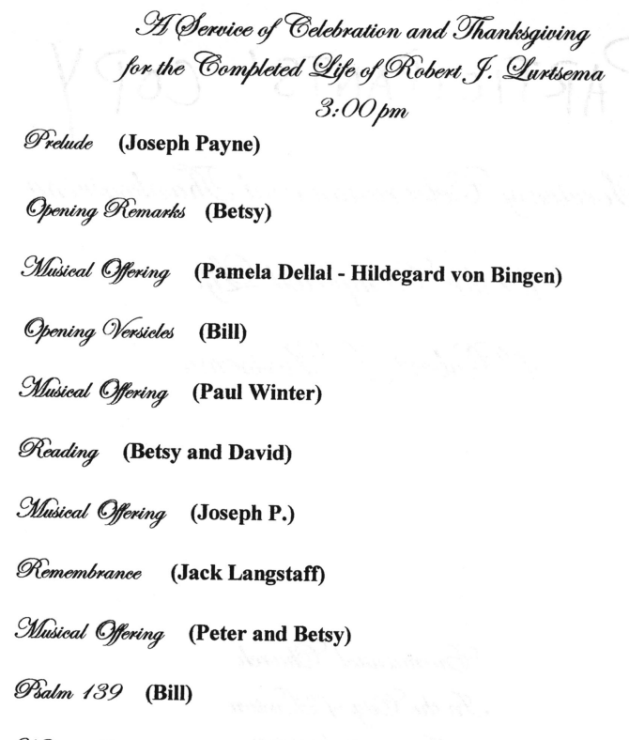
A page from the program of the Celebration of Life of Robert Lurtsema. Document courtesy of Emmanuel Church.
Peter: Can you give me one interesting or humorous story about your brother?
David: “When he passed away, they had a big celebration of life at [an] Episcopalian church somewhere in Boston; a big church. [Editor’s note: It was Emmanual Episcopal Church in Boston]. There were like 5,000 people there and they asked me to get up and speak. What the hell am I going to say? So, I figured I’d say what he said and I told a story that he had told me that’s true as far as I know. My brother was in demolitions in the Navy. The captain called him in and said, ‘Robert, you’ve been recommended for E4’, because he was an enlisted man. He was a 3rd class petty officer for three times and [he never took the test]. [The captain said,] ‘I want you to promise me you’ll take the test and you’ll study hard.’ Well, if he took the test and passed it, he knew that he would be extended because doing demolition work, they needed these guys. He said, ‘Okay, captain, I’ll take the test and I’ll study hard.’ So, he did and the captain called him in again and he said, ‘Robert, you’re the only man in the history of the Navy to get 100%…Wrong!’ I got up in front of 5,000 people to tell that story. It got a couple of laughs.”
Paying my respects. Photo by Mary.
Peter: I was in Rhode Island visiting relatives a couple of months ago and I went to visit Robert’s grave in Canton, MA, where his ashes are interred.
David: “I’m so glad you’re telling me. I know where it is now. Great. That’s where he was supposed to go but I never got the word what happened with that. All I got with the word was, was that Betsy [Robert’s girlfriend] was bitch moaning and complaining that he didn’t have some great, ah, thing built for him, and I think the thing about the family was, well [chuckling], why don’t you take some of the money and give it to him yourself?”
Peter: Since I’m writing about Robert’s “Christmas Stories” record, what was Christmas like as a child in the Lurtesma household?
David: “Well, I don’t have a lot of recollection of it because there was 10 years between us. So, in other words, when [Robert] was old enough to go in the navy, I was what, 6, 8 [years old], somewhere in there. So, I remember how the Christmas’ were for me but to remember him there, it wasn’t very often
Peter: But did you decorate and have a tree?
David: “We did. We decorated to the hilt. The tree [had] many lights and many ornaments. A lot of presents.”
Peter: Any other stories you’d like to mention about your brother?
David: “Another thing you may not know about him, as long as I’ve got it in my head…I don’t talk to anybody about this much, so I’ve got to bring it out of the memory. He was a child prodigy. His IQ was up like 160 or something. Off the charts. He graduated high school with 2 double promotions…he had 2 [college] degrees in 4 years…a degree in public relations and communications and, ah, I can’t remember what the other one was. It’s been too long now.
“He did children’s stories in Phoenix with a collaboration with some people there. He did, ah, what else? I can’t think right now.”
Peter: He wrote a couple of books.
David: “Yes. He wrote a book on music. I have the book. It’s basically written for musicians because most people wouldn’t be able to comprehend what was in there.”
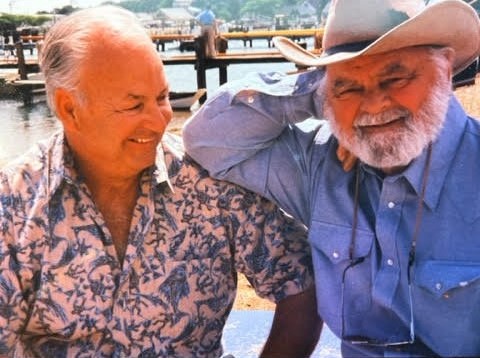
David (left) with his brother, Robert, on Cape Cod. Photo courtesy of David Lurtsema.
Peter: I only knew Robert as a listener of his show. What was he like as a person?
David: “When I got out of the Navy, I lived with him for a month or so. We both loved a lot of the same things but his lifestyle was more erratic than…erratic is probably the wrong word. I should say looser than I wanted to live. He liked to go to nudist colonies. That’s fine, but too much of anything is not good.
“I remember his apartment in, ah, oh, I can’t remember the name of the town.”
Peter: Cambridge?
David: “Yes. Thank you. He had an apartment in Cambridge. His bed was suspended by 4 cables coming out of the 4 corners of the ceiling and the cables were attached to springs to hold the thing together and the mattress on top of that. So, the bed was suspended off the floor. That was quite the thing. He was very innovative.
“I went to a psychic a few years after he died [to get] in touch with him. We had a lot of conversations back and forth and it was all taped…and the psychic is getting a kick out of his personality because he [had] a very unusual sense of humor. She caught that right away as soon as she started talking. She’d never met him. It was very revealing. The things I wanted to say to him about how I wished we had spent more time together and how he regretted not doing it because he didn’t really know who I was until later. A lot of good things happened from that. I was so glad that I had done it.”
In terms of Lurtsema’s gifted story telling on Christmas Stories, his brother says that stemmed from their father. “My father was a storyteller. He was a carpenter. He would come home in the evening and have dinner with us; my two sisters, my brother and I, and he would always tell stories about the day. He would talk about Mrs. McGillicuddy or Mrs. Schwartz, or whatever, with an accent that was theirs so you knew what nationality they were. It was kind of play acting but it was very entertaining for us. And of course, all that rubs off on everybody.”
“As far as his storytelling and so on”, David continued, “I have those records you’re talking about. There’s The Man Who Planted Trees. If you haven’t heard that it’s excellent. And Christmas Stories and so on. I went to a lot of performances when I was…in Boston…one where [Robert] was doing imitations, voice overs, I guess it was for Peter and what was it…”
Peter: “Peter and The Wolf”.
David: “’Peter and The Wolf’. Thank you. It’s late here. Later for you though.”
David said something at one point in our conversation that I wanted to end with because it had an important message for all of us: “He was somebody I loved greatly and admired, but we just didn’t spend enough time together and we were both very sorry about that.”
As with his radio program, Robert J. LurtsemaChristmas Stories is a refreshing break from the usual onslaught of holiday chestnuts we subject ourselves to on an annual basis. It requires one to slow down or even to stop and contemplate the reason for the season. Anyone could’ve recorded these stories, but not in Lurtsema’s inimitable way. As much as I enjoy listening to this wonderful album, I can’t help but feel sad knowing there will never be another show like his or another host like him. If he were still alive today, he’d be 92, and if his health allowed, I’m certain he’d still be playing those singing birds every morning. Two-plus decades after his passing, I still miss waking to his voice. He truly was the world’s greatest alarm clock. I don’t know what the voice of God sounds like, but I can only hope it sounds a lot like Robert Lurtsema’s, prolonged pauses and all.
My eternal thanks to David Lurtsema for sharing his memories, memorabilia, and photographs.
Trivia:RobertLurtsema was originally hired to host ‘Morning Pro Musica’ only on weekends. Not long after, he was promoted to the coveted weekday morning drive slot when the seat became available, yet he still continued to do his weekend shows, working 7 days a week for the next 22 years. In 1993, ‘Morning Pro Musica’ went back to weekends only, which Lurtsema hosted until his death. On June 12, 2000, at age 68, he died from idiopathic pulmonary fibrosis, a rare illness of the respiratory system.
Every word in every one of my articles is 100% written by me. I never use ChatGPT or any AI technology. Ever.
You can read more of my interview with David Lurtsema, see more pics of Robert, and get a Recommended Station in your in box every month by becoming a Patreon supporter today for just $1, and you’ll be helping to support my website blog. You won’t find articles like this anywhere else.
If you don’t care to join Patreon, you can still help by making a contribution in any amount via PayPal.
Be sure to sign up on my website’s home page to be notified when new blog articles get posted.
One Sound Burger to go, hold the pickles. Photo by Peter Skiera.
Model:Audio-Technica Sound Burger AT-SB727
Price: $199
Inputs/Outputs: Headphone out, Line out, Bluetooth 5.2.
In the box: Sound Burger,Quick Start Guide, Audio cable, USB-C cable.
Colors: Black, White, and Yellow
Pros: As much fun as you can have without getting arrested. Easy to setup and use. 12-hour playback. Replaceable rechargeable battery. Bluetooth 5.2. Good sound. Great retro style.
Cons: Lifting tone arm can be tricky. Can’t defeat the phono preamp. No volume control. Susceptible to vibration. No place to store locking pin. No non-grip surface. Speed controls are delicate.
Hungry Anyone?
Don’t drive up to your favorite fast-food joint and ask for a Sound Burger. They won’t know what you’re talking about. But chances are, people into vinyl records will. Audio-Technica first released the Sound Burger late last year. It sold out within 2 days and until recently, had been on constant back order. So, what is this thing that had people waiting months to get? The Sound Burger is a new, belt-driven, portable Bluetooth turntable inspired by the original model introduced by AT some 40 years ago. It’s practically become the hottest thing in audio since the phonograph was invented. Nipper now has something cool to listen to when he goes outside to do his business.
Hurry Up & Wait
Image from AT’s facebook page.
I was able to score my Sound Burger through a contact at AT, but still had to wait a few weeks to get it. Burgers are just now starting to show in stock on AT’s website, Amazon, and other places (links provided at the end of my article). I already own 3 turntables, so why get another one? My turntables are heavy, full size, and I don’t have room for them since I was forced to sell my home, so they’re packed up in boxes. I wanted a turntable that was easy to move, wouldn’t take up a lot of real estate, wouldn’t take up an afternoon to setup, and wouldn’t cost a lot. Those cheesy Crosley “suitcase” record players with their ceramic cartridges weren’t even a consideration.
Strange Looks
A portable turntable is a rather odd device when you stop to think about it. Are people really going to lug a box of records around and then plop down in a park, or wherever, and start listening while passersby gawk? It would come in handy if you frequented used record stores or flea markets and wanted to preview albums before you bought them. It would also be a very cool thing for a dorm room, provided no one steals your Burger. In my case, my Sound Burger is staying safely in my house. Besides, I get enough strange looks as it is when I go out in public.
Preparing Your Burger
Setting up the Sound Burger is as easy as deciding what condiments to put on a burger. The first order of business is to unscrew the locking pin on the back. Don’t forget to do this or you’ll damage the tone arm. Disappointingly, there’s no place to store it so be sure not to lose it. The next thing to do is plug in the included USB-C cable and start charging the Li-Ion battery. Now comes the fun part. Lift the lid, lift the tone arm, remove the rubberized clamp, place a record on the platter, apply the clamp (which cleverly doubles as a 45 RPM adapter), close the lid, turn the unit on, select 33 1/3 or 45 speed (sorry, no 78 RPM), and place the tone arm on the record to start the platter spinning. Your Burger is now well done.
Well, not quite. You need to connect it to something for the sound part of the Sound Burger to work. You have 3 options: There’s a stereo 3.5 mm headphone output, 3.5 mm stereo line output (audio cable included), and Bluetooth 5.2. There’s no volume control so if you’re connecting to something that has no volume control then you’re at the mercy of Sound Burger’s fixed level output.
Bite Me
Neither of my headphones have a volume control. Photo by Peter Skiera.
That output, as I discovered, is quite low, to the point where I wasn’t able to enjoy my cherished closed back Oppo PM-3 Planar Magnetic headphones. I switched to my Tin HiFi T4 wired ear buds but the sound level was even lower with those. Unfortunately, neither of those models have a volume control. Why AT failed to include a volume control on the Sound Burger is a mystery. A simple rotary volume control couldn’t have been beyond the realm of human engineering and couldn’t have been that costly.
Public Speaker
Thisisn’t what it looks like. Photo by Peter Skiera.
Above the Burger’s Power and Speed buttons is a simulated vented area that one might understandably mistake for a speaker grille. To be clear, the Sound Burger doesn’t have a built-in speaker. You must connect it to something to be able to hear it. This might strike you as odd that a portable audio device lacks a speaker, but I’m actually glad AT didn’t include a speaker. It would’ve added to the cost, would’ve been mono, would’ve sounded horrible, and would’ve had no volume control. Hands up anyone who wants to pay more for a useless feature.
Sound Burger’s Sound
The Sound Burger playing with my Cyber Shell Bluetooth speaker. Photo by Peter Skiera.
Putting the unfortunate headphone experience behind me, I next connected my Sound Burger via Bluetooth to my portable Muzen Cyber Shell portable Bluetooth speaker. It paired and connected almost immediately and sounded excellent (thankfully, the Cyber Shell has a volume control). I have read of instances where the Sound Burger’s Bluetooth refuses to play nice with certain Bluetooth speakers and ear buds so you might want to have a plan b from outer space just in case.
Be Nice
What a shelf system! Photo by Peter Skiera.
Speaking of playing nice, the most important Bluetooth test was my Dayton Audio HTA100 hybrid tube integrated amplifier which has a Bluetooth receiver. My Sound Burger refused to pair and connect to it despite repeated attempts and with it literally sitting right next to my integrated amp. This was incredibly disappointing because the HTA100 is my primary audio system which I use daily. Upon further investigation, it turned out my HTA100 was connecting to my Vizio TV’s Bluetooth even though my TV was totally turned off (not in standby)! Huh? I went into the Vizio’s settings menu and instructed the TV to forget the HTA100. Once I did that, the Sound Burger paired and connected to the HTA100 within seconds and remained connected. It then connected automatically every time I used it. Double yay!
What Do You Like On Your Burger?
The Sound Burger singing the blues via Bluetooth. Photo by Peter Skiera.
I was in a jazzy and bluesy mood so I began by playing a few tracks off of Richie Garcia’s vintage “A Message from Garcia” (Modern Harmonic MH-8078). This mono album from 1956 is not exactly the most vibrant recording, but it was enjoyable on the Burger nonetheless.
From there, I turned to the fantastic “Nina Simone Sings the Blues” (RCA LSP-3789). I bought this record a number of years ago through Vinyl Me Please but had never listened to it for various reasons. Now I know what I was missing. The Sound Burger did it justice and if it had a “repeat” function I would’ve used it.
My autographed copy of “The Drifter”. Photo by Peter Skiera.
I turned up the heat even more when I put on “The Drifter” by Mike Flanigin (Black Betty BBST-4068). Believe me when I say there isn’t a bad track on this album. When “Nina” began to play, I cranked up my integrated amp’s volume up to 45% and closed my eyes. It was a Sound Burger in paradise. Vocals were clear and strong, the bass was powerful, and I could hear each individual instrument.
To wind things down, I played my near mint copy of Shadowfax’s “The Dreams of Children” LP (Windham Hill WH-1038). Despite the recording being 38 years old, the music sounded perfect. I’m well acquainted with this record and I was pleased with everything I had heard.
Like A Version
The Sound Burger’s Bluetooth transmitter is version 5.2 which is one level below the latest 5.3 version. There’s not a lot of difference between versions 5.2 and 5.3, but 5.2 is superior to older Bluetooth iterations…version 5.2 is more stable and has improved latency (delay). It also requires less power in order to maximize battery playback time which AT puts at 12 hours on a full Burger charge (a USB-C charging cable is included).
Juice Me Up
Sound Burger’s single rechargeable battery cell. Photo by Peter Skiera.
While I’m on the battery topic, major kudos to AT for making the 2100mAh battery user replaceable. AT doesn’t yet sell replacement batteries but generic replacements can be easily sourced if you get desperate. I’m tired of Bluetooth devices with built-in batteries that aren’t user replaceable, requiring you to dispose of them (and the money you paid for them) when the batteries are spent.
Hum Along
If you want the best sound reproduction, there’s always the old-fashioned wired option via Sound Burger’s 3.5 mm line out (a short, inexpensive audio cable is included). Again, make sure whatever audio device you’re connecting to has a volume control. I need the wireless option since my HTA100 only has one set of analog inputs and they’re taken up by my cable box. One minor complaint- The Sound Burger has a built-in phono pre-amplifier allowing it to be conveniently connected to an auxiliary input. The problem is if you have a stereo receiver, integrated amplifier, powered speakers, etc., that has a dedicated phono input like my HTA100 does, there’s no way to defeat the Sound Burger’s internal pre-amp, meaning you can only connect it to an aux input. There’s also no ground screw on the Sound Burger, but so far, I haven’t noticed a hum problem.
Get To the Point
One of the keys to a turntable’s sound is its cartridge and stylus. In the Sound Burger’s case it’s the moving magnet ATN3600L which retails for $24 and is described by AT as good for “casual listening”. It’s the stock cartridge used on many budget turntables but don’t be put off by that. The ATN3600L enjoys a solid reputation in audio circles for its overall sound quality and tracking, with some claiming it sounds as good as cartridges many times its price. To my ears, it sounds good if slightly bright and aggressive. Regardless, it’ll have to do because there’s no upgrade path. But let’s be honest…the Sound Burger is not an audiophile piece of equipment, nor does it claim to be. Yet I have no complaints when it comes to its sound considering its price point and what it is…a Burger, not a Kobe A5 Wagyu Tomahawk steak.
Where’s The Beef?
Since the Sound Burger only weighs about 8 times that of a McDonalds’ quarter pounder, it’s very susceptible to vibration. Tap on its surface while it’s playing a record and expect to hear a corresponding loud pop from whatever you’re listening to it on. It’s too bad AT didn’t add some weight inside like a hunk of steel for a little more damping and a more quality feel, though I suppose extra weight would be counter to a product designed to be portable.
While we’re on the topic of touch, the Sound Burger’s plastic exterior is smooth and slippery…not the ideal surface for a portable device. Granted, it has a small handle on the back, but whenever I moved it, I instinctively lifted and carried it. I didn’t want it swinging around carefree from its handle and potentially banging into something. A rubberized coating and/or knurled areas to provide a good grip would’ve been appreciated. As a side note, in a couple of weeks I’ll be evaluating a generic carrying case.
Getting Technical
May the tracking force be with you. Photo by Peter Skiera.
Tracking force is the weight required for the stylus to follow the grooves in the record. Too little weight and the tone arm will lift off the record. Too much weight and the sound will be distorted and you could damage your record and stylus. I measured my Burger’s tracking force at 3.35 grams straight out of the box. The ATN3600L user manual recommends 3.0-4.0 grams with 3.5 grams being standard. Mine is within spec but I would’ve preferred it at least meet the standard and there isn’t any way to adjust the weight.
I Got Screwed
The Sound Burger’s two speed adjustment pots. Photo by Peter Skiera.
As you can see from the above graph, my Burger was exceeding the speed limit with 33 1/3 averaging 34.05 RPM, while 45 RPM topped out at 46.24 RPM. Being the anal audiophile that I am (some would say “anal audiophile” is being redundant), I decided to manually adjust the speeds using the 2 access holes on the bottom of the Burger along with a small, flat-head screwdriver. I was successful at adjusting the 45 RPM speed but 33 proved more elusive. The tiny white plastic adjustment piece broke off the potentiometer before I could finish my tinkering. As a result, 33 1/3 is now stuck at 27 RPM rendering it unusable (I’m in the process of getting my Burger repaired through Audio-Technica). Luckily, I saved this speed adjustment task for last. I had already completed my evaluation before tackling the speed issue. My advice to you is unless the speeds are way off, leave the trim pots alone. They’re too delicate to fiddle with and it isn’t worth the risk.
De Colores
Some like their Burger pink in the middle. Photo from AT’s website.
Let’s switch gears from technical to color, or Technicolor. The Sound Burger was first released in a limited-edition red version last November to celebrate AT’s 60th Anniversary and the 7,000 Burgers sold out. Earlier this year the Burger was made available in black and white, and more recently, in yellow, all priced at $199 each. Had it been me, I would’ve made the limited edition in silver which was the original and only color when it debuted back in 1983 as “Mister Disc” in the USA. I would’ve made the red color part of the regular line up. AT would’ve sold many more than 7,000 if red had been a standard color. It’s also a great color for marketing purposes.
“Mister Disc” was a weird name but it fit the era. Besides, the name “Walkman” had already been taken. In the UK and Japan, it was called the “Sound Burger”, and that’s the name AT used for this 2023 reboot. It’s certainly a more playful name though equally weird. Perhaps it was intended to hint at the fun that was in store for the new generation of Burger lovers.
61 Years and Counting
AT’s AT-LP2022 acrylic turntable is clearly different. Photo from AT’s website.
As I mentioned, AT has been around for almost as long as I have. It was founded by Hideo Matsushita in Tokyo in 1962. It was initially a phono cartridge manufacturer starting with the AT-1, the first affordable phono cartridge. Today, the company’s product lineup includes an impressive selection of turntables, headphones, microphones, professional equipment, and of course, phono cartridges. Their limited- edition AT-LP2022 turntable is a head turner with its dense, clear acrylic chassis, platter, and Shibata stylus. At $1,200, it’s a tad more expensive than the $199 Sound Burger.
Need A Lift?
Take care when lifting the Sound Burger’s stylus. Photo by Peter Skiera.
From comments I’ve heard and read, handling the tone arm is apparently the most difficult part of using the Sound Burger. There’s no space for a tone arm lift, so it has to be accomplished manually. I’m right- handed and I have a slight shake in my right hand, which hopefully is nothing serious, yet I had no problem managing the tone arm. There was only 1 instance when I slightly scraped the stylus on the record while lifting the tone arm. That said, I can see it being a little challenging for some users.
Light Me Up
I admit I’m a closet light freak. I love lights on my audio gear and I suspect I’m not alone. We’re part of the great silent audiophile majority. Lights might not make any contribution to sound quality but they definitely raise the fun factor. The Sound Burger has small power/charging/BT and speed lights, but the speed light only comes on when it’s set to 45 RPM. Had I been the Product Manager for this model (AT, if you’re listening, I’m available), I would’ve made the speed LED bi-colored so it would be one color for 33 1/3 and another color for 45 RPM. That way there would be a light on regardless of the speed setting.
While we’re on the topic of lights, I would’ve placed a single blue LED in the center of the Bluetooth pairing button instead of making the power light do triple duty. I also would’ve back lighted the “Sound Burger” name whenever the unit was on. Did I mention I love lights?
Have It Your Way
I’m not done. I would’ve included a downward firing LED mounted to the outside of the lid above the record on the side that houses the tone arm. Not only would it look very cool illuminating a spinning record, it would also aid in placing the stylus if you were looking to drop it on a specific track. The cost of these additions would’ve been minimal as would the power to light them, it would’ve further distinguished the Burger from the original model, and it would’ve multiplied the fun factory by ten.
May I Take Your Order?
Image from AT’s website.
Put simply, Audio-Technica‘s Sound Burger is the Happy Meal of portable turntables. Like fast-food, it’s convenient, fun, provides instant gratification, and sounds delicious. It even has a cover to prevent one’s drool from coating the platter. In a word, you’ll flip over the Sound Burger. Get it? Flip? Burger? See what I did there?
Disclosure: I purchased my Sound Burger at an accommodation price, though notin return for this review.
Main audio system used in this review: Dayton Audio HTA100 hybrid tube integrated amplifier with Bluetooth 5.0, Blueroom Minipod speakers with Transparent Audio Hardwired Speaker Cables on Perlegear speaker stands, Sunfire True Subwoofer Super Junior with SVS SoundPath subwoofer cable, and TrickleStar TS-1104-7 Tier 1 Advanced PowerStrip.
Did you enjoy this article? Help support my blog by becoming a Patreon supporter today for just $1 or make a one-time donation of any amount via PayPal.
Trivia (from Wikipedia): “Since the late 1990s, Audio-Technica supplied microphones and headphones for US television shows such as ‘Big Brother’, ‘Deal Or No Deal’, and the Rock and Roll Hall of Fame inductions, and several international events.”
Trivia (from Wikipedia): “In 2005, Audio-Technica developed ‘Uniguard’, a method for making microphones resistant to radio frequency interference from cell phones, Bluetooth devices, wireless computer networks, and walkie-talkies. 13 patents were involved in bringing the feature to fruition…”
Links to buy Sound Burger(I don’t receive a commission if you buy one):
This used to be a modest 1 room cottage. Photo by Peter Skiera.
When I was a kid, my parents owned a primitive beach cottage in southern Rhode Island. Don’t picture anything extravagant. After they bought the one room cabin, they hung a up bed sheet to create a “private” room. The sink had a hand pump that went to a well in the back of the house. There was no TV, no telephone, and no bathroom. Our neighbor across the street let us use their shower until we finally installed one of our own in the shed. It may have been primitive, but it was our little slice of paradise for some 17 summers. My mother nicknamed the cottage “Peace of Mind”. I drove by it last year and the original cottage is long gone, replaced by some monstrosity with central air on tall concrete pilings.
Its location is important to my story because it explains how I was able to pick up AM radio stations from New York. Along with Rhode Island beautiful music station WLKW, I credit these stations for sparking my interest in a career in radio broadcasting. The three NY stations I listened to were WNBC 660AM, WINS 1010AM, and WNEW 1130AM. All 3 are still around today in one form or another.
1. WNBC 66AM
Image from www.facebook.com/WNBCRadioTribute/
When I was a wee listener, WNBC-AM was a talk and “adult top 40” music station. It was the flagship radio station of the NBC radio network. I was around 12 or 13 years old at the time. This station was my gateway drug to Don Imus and Howard Stern, both of whom went on to become national shock jocks. One WNBC poster pictured Stern and Imus with the slogan, “If we weren’t so bad, we wouldn’t be so good.” If my mother had known I was listening to them she would’ve confiscated my radio!
In 1988, General Electric, who had purchased the NBC network, sold off all of NBC’s radio stations per FCC regulations during that time (one company couldn’t own both television and radio stations in the same market for fear of a monopoly). WNBC-AM was sold off and became WFAN-AM, the world’s first 24/7 sports station. WFAN still resides today at 660 on the NY AM dial (I use the word “dial” knowing radio “dials” don’t exist anymore).
Thanks to the miracle of Internet radio, you can listen to original WNBC-AM broadcasts, sans Don Imus and Howard Stern, courtesy of Time Warp Radio out of NY. The station streams at 128 kbps in MP3 but I must warn you, the sound quality of some of the recordings is sub-par. The source material is aircheck tapes. Back in the day, air check tapes were cassettes a DJ would use to record his air shift. The station’s Program Director used the tapes to critique the announcer’s performance. The tapes were typically “scoped”, only capturing the DJ’s chatter (the tape machine automatically went into record mode every time the microphone was turned on), not the music or commercials. However, the quality of such tapes is much better than some of what I’ve heard on this station. I have an aircheck tape from my time in radio and the quality is very good. Perhaps some of these tapes were late generation copies of the originals and/or were in poor condition.
You’ll hear the original announcers (with plenty of reverb, making them sound like they’re broadcasting from deep inside the Bat Cave), news, station jingles, and the original commercials. You’ll hear the music as well, but since these are aircheck tapes, there will also be segments where all you hear is the DJ introducing the songs and speaking at the tail end of songs. In other words, no music. You’ve heard the slogan, “all music, all the time”. During those segments, it’s all DJ’s, all the time. There are also segments where the program ends abruptly, presumably marking the point when the aircheck tape reached its end and stopped recording.
If you’d like a sound quality upgrade and more music, try 66 WNBC. It’s a tribute Internet radio station streaming out of NY that replicates WNBC’s playlists from the late 1970’s to the early 80’s with an occasional original station jingle but no announcers (and no annoying reverb). The first time I tuned in they were playing the top 66 (for “66” WNBC) songs of 1976. Another time they were running down the top 66 songs of 1982. Sweet.
If you want to relive the days when AM radio was still a primary source for listening to music, check out WNBC 660 Time Warp Radio and 66 WNBC. I’ve included the streaming links at the end of this article.
2. WINS 1010AM
WINS was one of the first all-news radio stations in the US and it still exists today on the AM and FM dials and on the Internet. In fact, I was in New Jersey briefly a couple of months ago and rented a car to get to my destination. I punched up WINS 1010 AM on the car’s radio and it instantly brought back memories of listening to WINS at our R.I. beach cottage all those years ago. After WINS switched to an all-news format in 1965, it had the sounds of teletype machines running in the background while the news was being reported. Originally, they had a live microphone stationed at the machines in the newsroom to capture the sound. Sadly, they stopped the teletype SFX several years ago which is a shame. Fast forward many years later when I read the news live on WPRO-AM, I played the sounds of a dot matrix printer in the background.
Be that as it may, if you don’t reside in the tri-state area, you can tune WINS on the Internet and hear what’s going on in New York and around the world. Give them 22 minutes and they’ll give you the world. Unfortunately, your imagination will have to supply the teletype sounds in the background.
3. WNEW 1130AM
Image from facebook.com/groups/148879591795762/
WNEW-AM was a massively popular radio station primarily playing music from the great American Songbook (not to be confused with WNEW-FM or WNEW-TV). So why, at 12 years old, was I listening to this AM music station? What can I say? I was a strange child.
I well remember WNEW’s wonderful specialty shows like Tony Bennett Time (Bennett actually recorded a jingle for the station), The Make-Believe Ballroom, and Sinatra Saturdays. Legendary WNEW DJ William B. Williams has been credited as the first to nickname Sinatra the “Chairman of the Board”. I also remember some of the DJ’s occasionally going off the rails and slipping in a Beatles, Bee Gees, or Stevie Wonder hit or some other song that had nothing at all to do with the great American songbook. I never understood that. Don’t get me wrong. I love music as much as the next person, but I also appreciate structure, and WNEW-AM wasn’t a free-form radio station. As a listener, it was like sitting comfortably on a train going 100 MPH and the engineer suddenly hitting the brakes without warning.
WNEW Station Director’s office, 565 5th Ave, NYC. Photo from the Library of Congress LC-G612-T-49671
The station wasn’t only known for its music. It spent a fortune building a first-class radio news team. At its height, WNEW’s newsroom had more than 26 reporters and writers. It was said to be the first music radio station that broadcast local newscasts every hour. According to writer Paul Colford, WNEW’s reporters roamed the country and the world, traveling “to Africa to interview Albert Schweitzer, they roamed the South to size up the civil rights movement, they broadcast from Vatican Square and Cape Canaveral.”
As time went on, the station began to show its age, as did its listeners, who ranged from 80 to dead. Such an audience was not appealing to advertisers. Fewer advertisers resulted in reduced revenue. This, combined with the fact that the days of AM radio stations playing music were all but over, resulted in WNEW’s death. Colford wrote this obituary: “WNEW-AM / 1130, the 58-year-old outlet for the music of Frank Sinatra, Lena Horne, Mel Torme, and America’s greatest songwriters, died today after a long illness marked by financial losses, anemic rating, schizophrenic programming, and the dismissal of practically every personality who made it special.”
The new owners, Bloomberg, changed the call letters and put in place an all-financial format. As the New York Times put it, WNEW went from Sinatra records to stock reports. It was the end of a slow, painful death. Prior to that, the station had been sold in 1986 and the owner’s cut costs and screwed around with the programming, adding talk shows and gutting the newsroom. It marked the beginning of the end…the Titanic started taking on water. The station changed hands again in 1988 and the new owners further contributed to its decline. In December of 1992, WNEW 1130 gently slipped below the airwaves.It’s hard to believe the station has been gone for more than 30 years and that makes me feel old and irrelevant.
Fear not: for, behold, I bring you good tidings of great joy, which shall be to all people. WNEW-AM is back! Well, sort of. Time Warp Radio, the same Internet radio network that brings you vintage 66AM WNBC broadcasts, also streams old WNEW-AM broadcasts. As with the WNBC stream, WNEW 1130 Time Machine’s sound quality at times leaves a little something to be desired, though it streams at an above average bit rate of 192 kbps. It also relies on airchecks, meaning there will be segments where you’ll only hear the announcer and no music.
The station’s playlist includes music from the 1920’s and 30’s, which makes no sense to me. All of that said, I’ll take it over nothing at all. In a way, the quality makes it even more authentic since music over AM radio wasn’t exactly high fidelity. It’s a gas to hear the original WNEW announcers, station jingles, weather, news (I heard a story on Watergate), and even the commercials the station played back then (Gimbels, Barneys, ShopRite, etc.).
Here’s a thought- How about WNEW-FM creating an HD2 station for WNEW-AM? WNEW-FM has had a string of failed HD sub-channels…all Christmas music, Smooth Jazz, and even a Russian language station (pause to scratch scalp). I would think a WNEW-AM HD2 channel would be a no brainer.
Other Options
I’m pleased to report there’s another option with consistently better sound quality: Metromedia Radio out of New York City. Metromedia was the company that owned WNEW-AM from 1956 until 1986. Metromedia officially closed in 2014 and Metromedia Radio, launched in 2010, operates with its blessing.
The station features former WNEW announcers and original jingles, yet the shows were recorded after WNEW went silent, which confused me. The station’s description says it streams “in the tradition of WNEW 1130…the world’s greatest radio station…with the help of former WNEW-AM and Metromedia Radio talent and executives.”
Joe Fay. Photo from LinkedIn
I got a hold of Joe Fay, Metromedia Radio’s General Manager, to help me understand what I was listening to. “About 12 years ago”, Fay explained to me in an email, “I was able to buy a large collection of various surviving reel-to-reel tapes from the WNEW-AM archive (about 200). The tapes were largely WNEW jingle packs, various promotional materials, and actual pre-recorded shows such as WNEW Music Spectaculars. I digitized everything and started the Metromedia Radio stream back in 2010. As I digitized, I also edited content, resulting in WNEW bumpers and the voiceovers of [WNEW announcers] Jim Lowe, Ted Brown, and William B Williams. It’s been really fun crafting this station. Thankfully, I have had the support of the Brown and Williams famil[ies].
“I also started a Facebook group”, Fay continued. “Via the group, I met up with former WNEW talent such as Bill Quinn, Dick Carr, and Marty Wilson. In 2014 we started producing radio shows for syndication. Unfortunately, that did not work out, but those shows were put into our Metromedia Radio library. Bill Quinn is still producing shows for us on a weekly basis. Additionally, I was able to connect with Sid Mark, Mark Suduck (former Metromedia Los Angeles) and Jason Wall along with other DJ’s who were interested [in] airing content on the station. Most recently I have been able to find and digitize about 100 mid 1970’s show[s] produced by William B. Williams.”
As to the origin of the music and the format, Fay told me, “The automated stream of music is from my personal collection. Our streaming of automated music is model[ed] after the Dick Carr, Middle of the Road format. Dick was the Station Manager at WNEW from 1967 through 1969. [The programming] is consistent with the music WNEW played from 1955-1985. Within the archive, I have old tapes labeled ‘Non-Stop Music Hours’ that also served as a source for building out my person music collection and would naturally be added to the automated stream. Artists like David Allen or Jane Morgan [was] unknown to me, until I listened to some of the old tapes. They are now on the playlist.”
That playlist remains much more faithful to the great American Songbook than the WNEW Time Machine stream, but lacks the authentic vibe WNEW 1130 Time Machine provides. You’re listening to actual WNEW-AM broadcasts on the Time Machine, whereas Metromedia Radio is more of a tribute station with Live365 commercials. Still, a high-quality copy can be almost as satisfying as the original, and that’s certainly the case here.
The last WNEW related Internet radio station I’ll mention is The Jonathan Station, named after famed WNEW-AM announcer Jonathan Schwartz. His is the only name (and voice) I remember from those summers listening from Rhode Island so long ago.
One of Schwartz’s record albums.
If his name sounds familiar, it should. Schwartz is the son of composer Arthur Schwartz (That’s Entertainment, You and the Night and the Music,Dancing In The Dark, and By Myself). He’s written several books including an autobiography and recorded a handful of albums. He was on the radio for nearly 60 years, most of that time on WNEW and later, WNYC. He also had a stint at Siriux/XM radio on their Sinatra channel.
Schwartz at the mic in 2018. Photo from Schwartz’s facebook page.
Schwartz’s on-air delivery was unique to say the least. He would talk for lengthy periods with frequent pauses, both of which are third rails for most DJs. He would recount stories of famous singers and songwriters, including Frank Sinatra. According to Wikipedia, “Sinatra himself was amazed by Schwartz’s knowledge of every song he had ever recorded.” Schwartz wrote the liner notes for the Sinatra release, The Voice- The Columbia Years 1943-1952, for which he won a Grammy for Best Album Notes in 1986.
Five years ago on Father’s Day, at the age of 80, Schwartz launched his own Internet radio station called The Jonathan Station. As you might have surmised from Schwartz’s background, it features music from the great American songbook. Surprisingly, Schwartz’s color commentary is nonexistent. You’d think he’d be all over the station since he named it after himself and has the name recognition. He didn’t even record any station IDs. It’s as if he went out of his way not to be on the air, yet his vast knowledge and gentle voice was exactly what I wanted and expected to hear. The Jonathan Station’s website says the station is “the home of Jonathan Schwartz”, yet whenever I tuned in, Jonathan wasn’t home. Schwartz did host live weekend programs on his station before he retired in 2021, but so far, I’ve yet to hear repeats of those shows. Individual shows are accessible for playback on The Jonathan Station website, but I wanted to hear them on my Internet radio as part of the station, not from a computer. After all, it’s The Jonathan Station, not The Jonathan Computer.
Instead, what I did hear was a show called “The Penthouse”. At first, I thought I had tuned the wrong station or that the station’s metadata was incorrect. Strangely, The Jonathan Station’s website makes absolutely no mention of “The Penthouse”. Likewise, The Penthouse’s website makes no reference whatever to The Jonathan Station! I donned my detective’s fedora and requested clarification from The Jonathan Station’s Program Director, Bob Perry, who coincidentally, also happens to be President of the company behind “The Penthouse”. Weeks have passed and I’ve yet to hear back but will certainly update this section if/when I do.
Legend has it, the last Sinatra song WNEW-AM played before going off the air was Frank’s cover of We’ll Meet Again. Thanks to WNEW 1130 Time Machine and Metromedia Radio, we have.
Tony Bennett Time
Tony Bennett, 1926-2023. Photo from Bennett’s facebook page.
One major drawback to such “set and forget” Internet stations is that they rarely break from their standard programming. However, a few days after his passing, Metromedia Radio played an old William B. Williams radio show that featured an excellent interview the announcer did with Bennett along with lots of his music. At least one station was paying attention.
You now have a plethora of stations that will give you a blast from the past. I’ve listed all their streaming links below for your convenience. If you’re a Recommended Stations supporter, your support helps to keep this blog and these kinds of articles going. To become a supporter and discover even more interesting stations, join today for just $1 and get my Recommended Station in your in box every month.
Trivia: During one of his radio shows,Jonathan Schwartz gave a negative review of the third record in Frank Santra’s “Trilogy” album. Unfortunately for Schwartz, Sinatra knew the man who owned the radio station and had Schwartz fired.
Trivia:Both 66 WNBC and 1130 WNEW were advertised as broadcasting in stereo. How could mono AM radio stations be in two channel stereo? In the 1980’s, some AM stations broadcast in stereo using 1 of 5 different competing systems, each requiring dedicated hardware to decode the stereo signal. The FCC adopted Motorola’s C-Quam (Compatible Quadrature Amplitude Modulation)system in 1992 as the AM stereo standard. That standard had already been employed years earlier in Canada, Australia, Mexico, and Japan. According to Wikipedia, there are 43 AM radio stations in the US still broadcasting in stereo using the Motorola system, most of which are small, independent stations.
Radio from a different era. Image from wnew1130.com
Trivia: In 1966 and 67, WNEW-AM partnered with the Superior Match Company to feature WNEW announcers on matchbook covers. Inside each matchbook was a coupon for free entry into NJ’s Palisades Amusement Park, which at the time cost 40 cents.
I profiled this Hitchhiker Station in January of 2020 when I was writing Recommended Stations for Como Audio’s blog. Theater Organ Radio is the kind of station name that gets my attention. To be honest, when I think organ music, I think of being at a hockey or baseball game, in church, or riding a vintage carousel. ATOS Radio, however, is not that kind of station.
The American Theater Organ Society funds and runs ATOS Theater Organ Radio. The ATOS is focused on the preservation and promotion of the theater pipe organ and its music. Founded in 1955, the non-profit has over 60 chapters worldwide with over 3,000 members. I wonder if their members are organ donors as well. Sorry, I couldn’t resist.
It’s hard for us to imagine going into a movie theater today and seeing and hearing a live organ, but in the 1920s and 30s when films were silent, the mighty organ provided the soundtrack. According to Wikipedia, there were over 7,000 organs in US cinemas between 1915-1933. Wurlitzer was perhaps the best-known theater organ and the company built more than 2,000 of them into the early 1940s. According to Smithsonian Magazine, in 1926 at its height, Wurlitzer shipped an organ a day. After the early 1930s, many theater organs were sold or scrapped. Less than 40 organs remain in their original venues today.
Ch-ch-ch-ch-Changes
Since I wrote about this station 3 years ago, there have been some important changes. For one thing, ATOS Theater Organ Radio now streams at 128 kbps in the AAC codec instead of MP3, so the sound quality is even better. Secondly, the station has added more music to their library which now includes 6,000 CD tracks, 2,500 vinyl remasters, 1,200 live concert recordings, 500 archival tracks (78’s etc.), and exclusive content drawn from their archives. There’s even a new station logo.
What will you hear on ATOS Radio? The selections are surprisingly diverse. Here’s a sampling of songs that were piped into my ears during my listening sessions: On the Sunny Side of the Street, My Heart Will Go On, Brahms Lullaby, They Can’t Take That Away From Me, We’ll Meet Again, The White Cliffs of Dover, The Way You Look Tonight, Send In the Clowns, Shaking the Blues Away, How Great Thou Art, As Time Goes By, Baby Elephant Walk, Smoke Gets In Your Eyes, Ebb Tide, The Man I Love, Send a Little Love My Way, and Puttin’ on the Ritz.
You won’t hear commercials (the station is funded via listener donations) though there are occasional public service announcements for ATOS sponsored events. There’s only one announcer- Steve Ashley- host of the specialty show, “Hot Pipes”. There’s also two “curated” specialty shows from two of ATOS’ chapters, Dickinson and Eastern Mass.
Summer Camp
One of ATOS’ previous Summer Youth Adventures. Photo from ATOS’ website.
ATOS sponsors a kind of annual organ summer camp mid-this month “designed for young theater organ enthusiasts who are interested in learning, developing, or refining their skills with the theater organ.” That should make for an interesting “what I did over my summer vacation” essay!
ATOS sponsors a kind of annual organ summer camp mid-this month “designed for young theater organ enthusiasts who are interested in learning, developing, or refining their skills with the theater organ.” That should make for a unique “what I did over my summer vacation” essay!
I reached out via email to Steve Worthington who recently retired after 30 years as ATOS Theater Organ Radio Producer, to get the story behind the station:
Peter: When did ATOS Radio first start streaming?
Steve: “The original stream was ‘Theater Organ Replay’ which featured older vinyl records and started in 2000 on live365. ATOS radio started in 2008.”
Peter: What decades does your music library span? What qualifies as “theater music”?
Steve: “Our library runs from 1920’s thru today, so basically 100 years. Theater organ music really spans a mix of entertainment played on the unit orchestra as built by Robert Hope Jones and Wurlitzer and refined by a number of other builders such as Barton, Kimball, Morton, Möller, etc.”
Peter: Do you play any rare recordings?
Steve: “Yes, we have a number of 78 [RPM] and acetate records in the playlist. Some of the most famous are those of Jesse and Helen Crawford.”
Peter: Are the recordings strictly solo organ or do some pieces include other instruments or vocals?
Steve: “There are lots of tracks that include more than just organ, be it vocals or more – examples are Billy Thorburn’s The Organ, The Dance Band & Me or recordings featuring Buddy Cole with [his] orchestra or big band, or Bob Hunter records with orchestra. Another example I’d [cite is] Gerhard Gregor with military bands.”
ATOS’ Steve Worthington. Photo from LinkedIn.
Peter: Do you know what and where the rarest working organ in the USA is?
Steve: “No such thing – lots of operational organs – there are remnants of one of the earliest Wurlitzer organs from Seattle in a Church in Spokane.”
Peter: Does ATOS Radio broadcast any live concerts?
Steve: “We have looked into live broadcasts of concerts but this is now mainly done through YouTube as video is as important as audio. All the concert material is recorded.”
Peter: Why do you encourage people to see organs in action?
Steve: “Not so much see as hear. Pipe Organs are about a presence that needs to be felt not just heard!”
Peter: Is there anything about organs or organ music that most people don’t know?
Steve: “Theater organs and church organs are very different and the repertoire is also different. Theater organs are about entertainment and a wow factor that can only be understood by attending a live theater organ event.”
The bimonthly ATOS Journal includes reviews and informative articles focused on past and present theater organ related activities, plus directories and other factual articles focused on documenting and teaching various aspects of the theater organ.
William Gelhaus sits on ATOS’ board and took over administration of the radio station in January of this year. I hit him up with a few more questions:
Peter: What’s the purpose of the ATOS Theater Organ Radio stream?
Bill: “To promote Theater Pipe Organs, to make people aware of them and the wide variety of music they can provide. It also provides background music for those that want a more-gentle sound.”
Peter: What are the top 3 countries where the bulk of your listeners are based?
Bill: “USA, England, Australia.”
Peter: Are there any particular recordings you’re very fond of?
Bill: “As to favorites, with 12,000 items in the library, it is really hard to pick one. I do tend to enjoy some of the more current interpretations of music from the 60s on. The fun thing is that the Theater Pipe Organ can play almost any type of music with a little work and imagination by the artist.
“One example is one of the younger artists records ‘backing’ tracks with full drums, synthesizer, and other ‘sounds’ and uses that to add to the experience. Others do duets with various instrument and vocalist, one even did several songs with full harp, not something you would expect to see or hear.”
ATOS’ Bill Gelhaus. Photo from ATOS’ website.
Peter: Do you know how low some of the recordings go? For example, 20Hz? Audiophiles and people with subwoofers will be interested!
Bill: “It depends on when and how the original recordings were made, and on which instrument. The pipe organ has a frequency range of 8Hz or below with sub-harmonics from a 64 ft pipe like those on the Atlantic City organ (typically most have 16 ft pipes with some larger instrument having 32 ft or equivalent) to 20kHz and above with the shortest pipe and their overtones (also the tuned percussion like bells, chimes, and the like, have very high harmonics). The instrument can also have a dynamic range of over 120db depending on the size of the instrument and its blower(s) and the voicing. You don’t want to spend a lot of time in a chamber when it’s being played. Of course, the older the recording, the less of a range, but it is surprising as to their quality.
“On the original recordings I’ve made to digital you can definitely see the subwoofer pumping. What’s interesting is if you are listening without it, you might not miss it, and then turn it on and you may not realize it’s there, but when you turn it off it’s like the floor disappeared. With today’s microphones and digital recorder[s] you can capture the full sound of the instrument.”
Peter: Back in the day, live organ music in a movie theater was standard, right?
Bill: “They were designed to accompany silent movies. That’s the reason they have what’s known as traps, percussion, and a toy counter. Today they are used still to accompany silent movies, along with walk-in/out music and stand-alone concerts.”
Peter: Anything else to add, Bill?
Bill: “If it’s in the online library you can request the system to play it, as long as it does not violate any of the streaming rules that exist.
“There are thousands more recordings that need to be saved, restored and transferred to digital in our archive. You can donate to its support at: https://membership.atos.org/donate/by-program
“Much of the current library has been ‘encoded’ over a 30-year period under various standards, requiring us to either re-in-code or ‘re-level’ the online library if the original source material is no longer available.
“We are also in the process of updating the software and website but it’s going to take a while.”
After the early 1930s, many theater organs were sold or scrapped. Less than 40 organs remain in their original venues today.
If you love the organ, or the theater, or just want to close your eyes and imagine how it felt to sit in a cinema 100 years ago, tune in ATOS Theater Organ Radio…and go ahead and turn up the bass a few notches!
Trivia (from Yamaha.com):“The biggest pipe organ in the world is the organ in the main auditorium of the Boardwalk Hall in Atlantic City, United States. It is so big that the number of pipes is not accurately known. Published documentation suggests there are 33,114 pipes, and it is said that there are at least 32,000.”
Trivia (from Smithsonian Magazine): “The Smithsonian’s instrument is a rare, completely original Wurlitzer donated by the estate of Lowell Ayars, a New Jersey music teacher, in 1993. Ayars kept it in museum-quality condition during the 30-some years it was played in his home. When Ayars died in 1992, he willed it to his friend Brantley Duddy, and Duddy contacted the Smithsonian, which gratefully accepted it for the musical instrument collection of the National Museum of American History. For now, it sits in storage, its burnished white-and-gold console protected by a sheet of plastic. But there are plans to restore it to glory.”
Did you enjoy this article? Learn about other stand-out and unique Internet radio stations every month by becoming a Recommended Stations supporter today for just $1!
Once upon a time, there was a popular TV Western called Gunsmoke. The show ran for 20 years, from 1955 to 1975, making it the longest running dramatic TV series ever. Over 630 episodes aired during that time span, not including 5 made-for-TV movies. The show frequently received top ratings and the series won 15 Prime Time Emmy awards. It outlasted NBC’s Bonanza and survived CBS’ infamous “rural purge” of the early 1970’s when it cancelled its Western-themed shows. A few years later, in 1975, without any advance notice to the show’s cast, producers, or the viewing public, CBS unceremoniously pulled the plug on Gunsmoke.
Many of you probably remember the series or have at least heard of it. What some of you may not know is that Gunsmoke the television show was adapted from a radio series by the same name. It was 71 years ago this month when Gunsmoke the radio series first took to the airwaves on the CBS Radio Network. The Western drama aired on the radio every week for 9 years.
For the varmints who don’t know, Gunsmoke was set in Dodge City, Kansas, and centered around Marshal Matt Dillon’s efforts to enforce law and order in the wild west. Other key characters included Dillon’s Deputy, Wesley Proudfoot, Kitty Russell, owner of the local saloon (and Dillon’s love interest), Chester Goode, Dillon’s assistant, and Doctor Charles “Doc” Adams, the town physician.
Whoa, take ‘er easy there, Pilgrim.
During the entire 20 year run of the TV series, actor James Arness played the lead character, U.S. Marshal Matt Dillon. The 6’2” tall Arness looked and acted as if he was born for the part. He bore a slight resemblance to John Wayne and even sounded a bit like Duke. Legend has it Wayne was offered the starring role but turned it down.
In the radio series, however, William Conrad played Matt Dillon. You’ll remember Conrad as the 5’7″, 260 pound detective in the popular 1970’s TV detective series, Cannon. Nobody could’ve looked more the antithesis of an 1870’s Marshal than Conrad. I pity the horse that had to transport him. But this was radio, not television. Conrad had extensive experience in radio and it was his voice, as deep as Hells Canyon, that rightly earned him the part.
Rocky and Bullwinkle
Since I’m focusing on the Gunsmoke radio program and he was the star, allow me to devote a few sentences to Conrad. He was born in Louisville, Kentucky in 1920, the son of movie theater owners. He became a fighter pilot in World War II and was a producer-director of the Armed Forces Radio Service. He directed numerous films and TV episodes and acted in many more over his 5-decade long career. He was the narrator for The Fugitive, The Adventures ofRocky and Bullwinkle cartoons, and Buck Rogers in the 25th Century. He married 3 times and had 1 son. His last starring role in a TV series was Jake and the Fat Man, a crime drama that ran on CBS for 5 seasons. Conrad died in February 1994 of a heart attack.
From Mark to Matt
Before the Gunsmoke radio series began, two different pilot episodes were recorded, both in 1949. The Marshal’s name for the pilot episodes was Mark Dillon and Conrad didn’t play the lead role in either episode. Neither ever made it on the air and the hero’s name was later changed from Mark to Matt Dillon.
For Adults Only
Unlike other radio Westerns of the era such as The Cisco Kid and The Lone Ranger,Gunsmoke was strictly geared for adults. It tended to be somber and often featured explicit and violent content, yet is generally regarded as more realistic than its television counterpart. From the radio show’s introduction: “There’s just one way to handle the killers and the spoilers and that’s with a U.S. Marshal and the smell of gun smoke!” Or as William Conrad as Marshal Dillon put it in his baritone voice: “[I’m] the first man they look for and the last they want to meet.”
Being the radio geek that I am and having been employed in said industry for years, I’m continually amazed at the work that went into these old time radio productions. Listening to the Gunsmoke radio shows, I put aside the story lines and concentrated on the other elements…the quality of the scripts, the music, and of course, the all-important, multilayered sound effects. An enormous amount of effort went into each and every weekly episode and the quality still shines through 7 decades later.
James Arness chasing down outlaws on Gunsmoke. Image from insp.com
Watch and Listen
If I’ve managed to inspire you to catch Gunsmoke the TV show, you’ll find the series airing weekday afternoons on the MeTV network (which, incidentally, also airs Cannon). Can’t get enough? The INSP cable network airs Gunsmoke episodes multiple times throughout the day and evening. Tarnation! On the other hand, if you’d prefer to acquaint (or re-acquaint) yourself with the original radio show, check out Internet Radio station WRCW Radio – Home of Gunsmoke, streaming out of Virginia. Toto, I’ve a feeling we’re not in Dodge City, Kansas anymore.
Most OTR (Old Time Radio) Internet stations play a variety of old time radio programs. Some OTR stations are genre specific like mystery/science fiction or comedies. There aren’t too many that dedicate themselves to one specific series like WRCW Radio – Home of Gunsmoke does. With WRCW Radio, it’s all Gunsmoke, all the time. I’m talking hundreds of episodes all broadcast on one radio station. You’ll even hear vintage adverts for Vicks cough drops and the original sponsor, L&M cigarettes. Interestingly, L&M was founded in 1873, the same time period the Gunsmoke episodes were set in. It’s bizarre to me to hear cigarettes advertised as having “flavor” and being “light and mild” with an “easy draw”, not to mention the white “miracle tip” filter. The L&M brand still exists today unlike some of their customers.
25 Years of Gunsmoke Radio
There are other Gunsmoke-only Internet radio stations like a similarly named radio station, Home of Gunsmoke. That station only streams at 64 kbps and it’s been my experience that this is typical of the majority of OTR Internet radio stations. WRCW Radio – Home of Gunsmoke streams at 128 kbps. It’s a minor point since the quality of the old time radio mono recordings aren’t exactly high fidelity, but I applaud WRCW Radio for going above and beyond. They’ve also been streaming Gunsmoke longer than most. The station celebrated its 25th Anniversary just last year. In 2005 it was nominated as Live365’s best station.
I spit-shined my Marshal’s badge, hopped on my trusty horse, and tracked down Marlene Micele, WRCW’s Founder. I asked the little lady what her inspiration was to start WCRW Radio – Home of Gunsmoke. “The inspiration to start the station came from my memories of hearing the show on the radio when I was only a few years old”, Micele wrote me. “I didn’t like the TV version of Gunsmoke”, she added.
As I mentioned, WRCW Radio plays all the Gunsmoke shows, well over 400, with one exception. “I air all the episodes that are available”, Micele told me. “There were many repeats during the show’s run, and I have removed them from the broadcast as to not be repetitious.”
Pull Up A Chair
One mystery that still endures…why William Conrad didn’t get the starring role in the Gunsmoke TV series after successfully playing the lead for 9 years on the radio. It’s been implied his girth was the reason behind the snub. Micele commented, “I quote from hearing Dennis Weaver [who was in the TV series] tell it: ‘The scene called for Conrad to jump up from the chair, and when he did, he got stuck because of his weight.’ It was clear Gunsmoke the TV series was either going to need bigger chairs or a thinner Marshal.
Just the facts, ma’am.
WRCW has some sister stations worth noting which also stream at 128 kbps. If Gunsmoke isn’t your cup of wild west whiskey, there’s WRCW Presents Dragnet, dedicated to Dragnet, another very popular TV show that began life as a radio series. WRCW Radio 2 Home of the Old Time Westerns airs Westerns in general, and WRCW Crime Story streams vintage radio crime dramas. Perhaps the “RCW” in WRCW stands for Radio, Crime, Westerns.
“Unlike other radio Westerns of the era such as ‘The Cisco Kid’ and ‘The Lone Ranger’, ‘Gunsmoke’ was strictly geared for adults.”
Without getting ornery, I have two quick cons about this Internet station. First, it’s not non-commercial, so be prepared to hear 2 minute commercial sets beyond the original vintage sponsorships. The commercials help reduce the station’s cost of the streaming platform and is often a necessary evil for Internet stations to exist.
The other quibble I have is that KCRW Radio’s metadata doesn’t identify the original air date of each Gunsmoke episode. The title of every episode is displayed but it would be interesting to know when they first aired. This information is readily available so I don’t understand why it’s not included. To be fair, the other Gunsmoke Internet stations I checked out also failed to indicate the broadcast dates.
Gunsmoke still looks and sounds pretty darn good at 71 years old. Without it, one has to wonder whether shows like Yellowstone, 1883, and 1923 would exist. Unless you’re yellow-bellied, rustle up some Gunsmoke on WRCW Radio or get out of Dodge!
Trivia:William Conrad wrote Gunsmoke radio episode #59, “Sundown”, which aired on June 6, 1953. He also directed two episodes of the TV series.
Trivia: James Anress, who portrayed Matt Dillon in Gunsmoke the TV series, had a famous brother…Peter Graves, who starred in his own hit television series, Mission: Impossible.
Arness is best, but there’s Festus for the rest of us.
Trivia: The Gunsmoke TV character, Festus Haggin, played by Ken Curtis, released several records. Long before Gunsmoke, Curtis was a professional singer and had a brief stint as lead singer with the Tommy Dorsey band in 1941 after Frank Sinatra’s departure.
A sampling of metaphors by Festus Haggin from the Gunsmoke TV series:
He ain’t got the gumption to pound sand down a rat hole.
I thumped him ’till his ears rang like the liberty bell.
Crookeder than a dog’s hind leg.
Hold `yer taters.
I’ll get onto you like ugly on an ape.
He can’t see past the brim of his hat.
This here stew will put muscles in your whiskers.
It’s hot enough to fry a horseshoe.
Tighter than the feathers on a prairie chicken’s rump.
Did you enjoy this article? Help support my blog and discover more great Internet radio stations like this one by become a Recommended Stations Patreon supporter for just $1. You’ll receive a new Recommended Station in your in box every month as well as information about strange radio stations you never knew existed. Join today and get a 7 day free trial.
The Como Audio Musica. Photo courtesy of Como Audio, Inc.
It’s been at least a year, possibly two, since I last published a list of the most tuned Internet radio stations by Como Audio owners around the world. As many of you know, I worked for Como for over 7 years as Vice President of Product Development, and more recently, General Manager. I found it fascinating to learn what stations our customers were listening to and enjoyed bringing these lists to you on a semi-regular basis. With the company shutting its doors literally just a couple of days ago, I thought I’d author one final article on the most popular stations amongst Como Audio users and also amongst the millions of people using the Frontier Silicone platform.
Accordingly, here are the top 50 Internet radio stations ranked from the most to least listened to by Como Audio listeners:
Radio Swiss Jazz
France Inter
WCRB Classical
Rás 1
WQXR 105.9 FM
BBC World Service
mvyradio
NPO Radio 1
BBC Radio 4
Rás 2
BBC Radio 6 Music
VRT Radio 1
WNYC 93.9 FM
Bylgjan 989
WDNA 88.9 FM
Classic FM
NPO Klassiek
France Culture
VRT Klara
FIP
RTL
Radio Swiss Classic
Deutschlandfunk
BBC Radio 3
France Musique
Radio Italia
franceinfo
Ö1
NPO Radio 5
SomaFM – Left Coast 70s
WFMU
NPO Radio 2
WBGO Jazz 88.3FM
WGBH Boston Public Radio
KQED
KEXP 90.3 FM
WBUR 90.9 FM
La Première RTBF
VRT Klara Continuo
98.7 WFMT
Classical California KUSC
BBC Radio 2
Jazz24
Classical California KDFC
VRT Studio Brussel
Hitradio Ö3
Radio Paradise
Radio 10 – 60s & 70s Hits
VRT Radio 2 Oost-Vlaanderen
In scanning through the above list, it’s not surprising to find Radio Swiss Jazz in the top spot. Anytime I’ve published this list it’s always been number one, and for good reason. Radio Swiss Jazz was stored in preset #1 in every radio we made and it was our go-to station whenever we performed product demonstrations. Streaming in the superior AAC audio codec at 100 kbps and playing a great selection of mainstream jazz, the station always sounded fantastic.
Now, here’s the list of the 50 most tuned stations by everyone using a Frontier Silicon platform-based radio of which there are millions around the world.
SWR3
Deutschlandfunk
BBC Radio 4
WDR 4
Radio Nowy Świat
RadioMv – Slavic
France Inter
NDR 1 Niedersachsen Hannover
ANTENNE BAYERN
NDR 2 Niedersachsen
SWR1 Baden-Württemberg
BBC Radio 2
BAYERN 3
Hitradio Ö3
Radio Paloma
BAYERN 1 Oberbayern
1LIVE
RTL
NPO Radio 1
Radio 357
ROCK ANTENNE
RTÉ Radio 1
radioeins
WDR 5
SWR4 Baden-Württemberg
Absolut relax
WDR 2 Rheinland
RMF FM
Klassik Radio
franceinfo
NPO Radio 2
NPO Radio 5
SWR1 Rheinland-Pfalz
OLDIE ANTENNE – Oldies but Goldies
Classic FM
MDR JUMP
hr4
HIT RADIO FFH
hr1
BBC Radio 3
BR-KLASSIK
N-JOY
France Culture
Radio U1 Tirol
MDR THÜRINGEN Erfurt
Sky Radio
Bremen Eins
Radio Swiss Jazz
FIP
BR Heimat
The thing that stands out immediately to me with this list is there’s only 1 or 2 stations from the USA. That’s because the majority of these listeners reside outside the USA. Surprisingly, unlike the Como Audio list, Radio Swiss Jazz ranks almost at the very bottom.
The Como Audio Internet radio station directory currently has over 68,000 free stations and grows every month.
It never fails to surprise me how many people have no idea Internet radio exists or even understand what it is. So, I get very excited when people discover it and the wealth of free entertainment it offers, regardless of what brand radio they use. Unfortunately, many users are discouraged by the amount of effort it sometimes can take to search through almost 70,000 Internet stations. That’s why I launched Recommended Stations via Patreon. With Recommended Stations, I do the searching for you and recommend a different radio station every month in addition to uncovering a bizarre station you never thought would exist. This month’s Recommended Station is unique in that it mixes two different music genres. Most radio stations are dedicated to a single genre, but not this station. Last month’s Hitchhiker Station (the name I give strange stations) is dedicated to the oral orifice. If this sounds interesting, sign up for a free trial using the link at the bottom of this article. And if you’re a Como Audio customer, join at the Elite level and I’ll be available to address any Como Audio tech support questions you might have about your music system.
I get very excited when people discover it and the wealth of free entertainment it offers, regardless of what brand radio they use.
That’s me with Como Audio’s founding CEO Tom DeVesto in our previous Boston office measuring the voltage of a Solo. Photo by WCVB TV.
Farewell Como Audio
As we started to wind down Como Audio last month, I personally received emails from many people thanking me for their music system(s) and for my assistance over the years. It was a lot of work developing and voicing every model while keeping to a totally unrealistic schedule. We also provided over- the-top customer service, especially for a very small company with limited resources. There were many instances where we took care of customers who were very clearly in the wrong or were downright unreasonable, but CEO Tom DeVesto always placed a very high value on customer support. We made our share of mistakes as well, but we always did our best to admit to them and to try to make them right.
The lats 2 years were difficult ones. You have no idea how hard we worked to try to keep the company going and the sacrifices that were made. As part of the cost saving measures my hours were gradually reduced to the point where I was only working 1 day per week. In November of 2022, I was forced to sell my home because I could no longer afford it. As was my luck, the red hot housing market had cooled off by then and I didn’t get the price I should have. I’ll put my violin back in it’s case now.
We were all hoping things would turn around for Como Audio but they never did. In the end, we had to face the reality that the business just wasn’t sustainable. Our most popular model, Musica, proved to be our chief downfall because we couldn’t get them in a timely manner due to parts shortages, high required order quantities, and price increases.
I may not have been a doctor saving lives or a scientist curing diseases, but it was very gratifying to bring music into people’s lives, especially during the pandemic when we were all isolated. Sadly, Como Audio is now history, but Internet radio lives on. As we were fond of saying to our customers- enjoy the music.
A view from Lake Como in Italy. Photo by Peter Skiera.
Trivia:Como Audio was founded 7 years ago last month and was named after beautiful Lake Como in Italy. It’s the third largest lake in Italy. Actor George Clooney owns an 18th century, 25 room mansion on Lake Como which he bought after falling in love with the area while on holiday. He was made an honorary citizen and often spends the summer months there.
Trivia: That’s Como Audio General Manager Peter Skiera’s voice speaking the confirmations from the Como Blu Stereo system.
Trivia: The default preset Internet stations in presets #7 & 8 on Musica were hand picked by Peter Skiera.
Trivia: While brainstorming names for our first two models, Peter Skiera proposed naming them Musica 1 & Musica 2.This was rejected in favor of Solo and Duetto, but our top of the line model was named Musica. Skiera also introduced the hickory finish.
Trivia:Peter Skiera started with Como Audio before the company had an office. He would meet with Tom DeVesto at DeVesto’s home on Cape Cod or at a cafe in Hingham, MA.
Enjoyed this article? Please help support my website blog and Internet radio stations:
In Happy Hee Haw New Year Part 1 I wrote about the interesting backstory to the classic country comedy show, Hee Haw, and featured an interview with original cast member Lulu Roman.
In Part 2 I conclude my series with two additional original cast member interviews…Jana Jae and Buck Trent. Sit back and relax. As Roy Clark and Buck Owens said in the opening of one episode, “it’s time for singing and it’s time for jokes, so gather ’round and join us, folks.”
Jana Jae
Jana Jae and her blue violin.
Jana Jae took up the violin at age 2, albeit a miniature version. She has a degree in music and studied at the Vienna Academy of Music. Buck Owens hired her to be in his Buckaroos band which led to multiple performances on Hee Haw. Her repertoire isn’t limited to country music. Jae has played the Montreux Jazz Festival, Wembley Festival, and the New Orleans Jazz Festival. Known as “the first lady of country fiddle”, she’s toured Australia, Africa, Brazil, Japan, and the Philippines. In addition to Buck Owens and Roy Clark, she’s performed with Chet Atkins, Ricky Skaggs, The Oakridge Boys, Mel Tillis, Ray Stevens, and the Nitty Gritty Dirt Band. Jae has several albums under her belt and also founded her own Fiddle Camp and Music Festival which takes place in Grove, Oklahoma.
Peter: I know you have many fond memories, but can you share a specific “Hee Haw” memory?
Jana: Working alongside some of the many wonderful guest stars was a real eye-opener to me! Roy Rogers & Dave Evans, Johnny Cash, Kenny Rogers, and so many more – I loved it! One funny thing was when Junior Samples brought his jug to our taping – his real, authentic moonshine jug thrown over his shoulder – sip, sip, sip! I think that was the first and last time on set, but it proved to me he was the real deal!!
Peter: Give me a sense of what it was like during one week of recording for “Hee Haw”. Did you rehearse beforehand?
Jana: Since I was a member of Buck’s band, we planned our time very efficiently. We had recorded some of the tracks ahead of time, and we all generally knew the songs and arrangements, at least Buck’s vocals (which he sang live on set). We would usually put in a full day in front of the cameras, doing all Buck’s songs together, then all of the cast songs together, then all the cornfields, the fence shots, whatever guests were scheduled, any solos or group fiddle numbers, etc. They had a detailed schedule for a couple weeks, then we left. It was really quite efficient – and always great fun!!!
Peter: Do you have a favorite performance from “Hee Haw” or do they all kind of blend together now? Did you perform before an audience or were applause tracks added later?
Jana: I sure enjoyed the cast songs and the group fiddle numbers, still favorites, but I really enjoyed everything we did on Hee Haw! We performed before a small audience of friends and cast members, seated on hay bales with backs to the cameras. I was so surprised when I first arrived on set – I had expected every show in an auditorium packed full! Not! They filmed, gathered all the footage, then would piece together the shows, add effects or the barnyard animals going across the screen, lots of fun things. We never knew who or what would be in a finished show – it was amazing how each show was done! Genius!!
Peter: Why do you think the show was so popular?
Jana:Hee Haw was a family show! It was a weekly family event before we had hundreds of channels to choose from, the entire family sat down to laugh and enjoy Hee Haw together – it was a fabulous show that really united families across America! It was fast-paced, full of fun, corny but funny humor, comedy sketches, and tons of great music, some clap along tunes and also current hits with stars who loved the exposure. And of course, the girls got lots of attention, but still fine for the whole family to enjoy. Everybody who was anybody wanted to be on the show!!!
Peter: Your famous blue violin was a gift (or an order!) from Buck Owens and you still use it to this day. You weren’t too keen on it at first but it must have become very special to you. Why was Owens insistent you play that specific violin?
Jana: He thought it would look good on camera and be different from Don Rich’s red-white-and-blue fiddle. And he was right!! It gets lots of attention!
Peter: You were married to Owens for a short time but you both remained friends until his passing, right?
Jana: Yes!
Peter: Buck Owens left “Hee Haw” in 1986. Were you surprised by the comments in Owens’ autobiography about only being a part of “Hee Haw” for the money? He always looked to me like he was genuinely having fun.
Jana: Buck valued money because he grew up poor and really wanted to make plenty so he would never be poor again! He was always fun to be with and I know he genuinely enjoyed being on Hee Haw! We always had a great time!
Friends for life: Jana Jae (left) performing live on stage with Misty Rowe, Lulu Roman, and Buck Trent. Photo from Jae’s Facebook page.
Peter: What’s it like performing alongside some of the original “Hee Haw” cast members again? The Kornfield Friends came about almost by accident, right?
Jana: After I bought Roy Clark’s bus and we had such fun on the road, I had been talking for years to many managers about a Hee Haw road show. It kind of stayed on my back burner, but no real dramatic interest for a long time. It evolved right after we all were together again for producer Sam Lovullo’s memorial celebration. Sam really united us all – our Big Daddy! We all wanted to pay tribute to him and his contribution to so many of our careers, and after the memorial, where everyone either spoke or performed a song, lots of us went to dinner at Johnny A’s. They had a really good house band, and they kept asking me to play the fiddle (which was all put up and tucked away in the trunk of my car). I finally said I’d play if I could have a little help from my Hee Haw friends, and Misty immediately said, “I’ll dance if you’ll play!” We had a ball, and needless to say, we brought the house down! I talked to Misty about doing a show at one of the three summer festivals I present on Grand Lake in Oklahoma. She came and we absolutely had a hit! So, I added Buck Trent and we did several shows with that configuration, and Misty had a genuine cornfield that was a hit with the crowds. I had booked Lulu on a couple of our festivals also, so I asked Lulu to do some shows with us I formed an LLC, fronted all the initial start-up costs with my band and my bus, and Kornfield Friends was born! I probably won’t ever get my investment back because just as we were really going full steam ahead, COVID hit and wiped out our 2020 year full of bookings! Whatever evolves, it was worth it – and my dream goes on. We’ve taken a breath, but we’re still around, I still have the bus and the band and hope we’ll visit many more towns across the country. It’s a very special thing to meet in person the audiences who have watched us on tv over the years! I always felt the Hee Haw cast was like extended family. I treasure that family, including the wonderful family audiences who watched us over the years!
Peter: You’ve accomplished a great deal in your life- founded a fiddle camp and music festival, played alongside some big names, and you’re an outstanding musician in your own right. But for many people, you’ll always be Jana Jae with the blue violin from “Hee Haw”. Does that bother you?
Jana: I love it! At first, I was shocked by the blue fiddle they gave me to play on Hee Haw – I was kind of a purist with my wonderful Italian violin made in 1750 –but after receiving fan mail addressed to “the girl with the blue fiddle”, it became sort of my trademark – I always play the blue fiddle in my country concerts!
Peter: What artists/music do you listen to when you have the time? Do you prefer records, CDs, or downloads?
Jana: Whatever is handy at the time – I can barely keep up with the opportunities on all the new online music platforms. Great fun to surf a bit, and I still like YouTube for being able to pick and choose easily. Of course, I have tons of vinyl, CDs, etc., but find I listen most online now.
Peter: Do you find music keeps you feeling young and energetic?
Jana: Absolutely – I can’t imagine what I would do without music in my life – it’s definitely in my blood, a life source! It refreshes me every day – and I’d love to spend more time creating music! I just want to stay happy, healthy, and keep making music every day of my life. That is being blessed, and hopefully it blesses others as well! That’s the real joy – to share music!!
Buck Trent
Buck Trent, picking and grinning.
Charles W. “Buck” Trent has played the bajo since age 10. He’s performed with such luminaries as Bill Monroe, Porter Wagoner, Roy Clark, Marty Stuart, and Dolly Parton (he played lead guitar on Parton’s Jolene and I Will Always Love You). He and Roy Clark were the first country music duo to tour the Soviet Union in 1976. Trent’s received many awards over the decades and has appeared on numerous TV shows including The Tonight Show, Mike Douglas Show, and Dinah! He invented the electric banjo but also plays the steel guitar, electric bass, mandolin, and guitar. His latest CD is called Spartanburg Blues and features Dolly Parton, The Oak Ridge Boys, Vince Gill, David Frizzell, and Marty Stuart.
Peter: I’m sure you’ve never been asked this before 😊, but how did your trademark “Oh Yeah!” and thumbs up thing come about?
Buck: The “Oh Yeah!” and thumbs up came about while taping my Talkin’ Blues [song]. After I sang the punchline to the joke, there were a few beats left and I had to have something to say. So, I said “Oh Yeah!” and gave the thumbs up!
Peter: How were you able to tape 13 Kornfield sketches back-to-back without it getting old real fast?
Buck: The Kornfield jokes were usually with different people so it was fun. The jokes were so corny and the more you messed them up the better it was.
Peter: Can you give me one favorite “Hee Haw” memory?
Buck: My favorite memory from Hee Haw was the day Roy Rogers and Dale Evans taped the show. He was my childhood hero. I went over to him to introduce myself and he said, “I know who you are Buck, I watch you every week!” That made my day!
Oh Yeah! Trent in 2019 performing at the Grand Ole Opry House where Hee Haw was taped. Photo from Trent’s Facebook page.
Peter: “Hee Haw” was one of the first shows to air bloopers. Is there one that sticks out in your mind? Did you have any bloopers?
Buck: There were a lot of bloopers. Junior Samples took 14 takes on the word “pollution”. He couldn’t pronounce it. Roy Clark had to get up and down with Junior 14 times. It wore Roy out! I’m sure I had a few but I can’t remember any.
Peter: When did you leave the show and why?
Buck: I left in 1983 or 1984. The reason I left was I had quit working with Roy Clark and went out on my own. I was just phased out of Hee Haw.
Peter: Was “Hee Haw” a blessing or a curse? What do you think when you watch the reruns today?
Buck: It was a blessing for me and a lot of the others. I like watching the reruns. We did some great picking and singing on that show. We had the best guests on it, too.
Peter: I have to admit, I got a bit choked up watching you interacting with Roy Clark during the 2012 “Salute To The Kornfield” reunion.
Buck: The reunion was fun. Roy and I just picked up where we left off. It was so special seeing everyone again. There were so many that died after we taped it. So sad to lose so many friends.
Legendary country stars Buck Trent and the late Roy Clark. Photo from Trent’s Facebook page.
Peter: What was it like working with Roy Clark?
Buck: Working with Roy was a lot fun. They said we had a wonderful time! Ha ha! We traveled the world together. Our dueling banjos is still a hit. No one has done it better than us!
Peter: How is it playing with the Kornfield Friends from “Hee Haw“?
Buck: The Kornfield Friends concerts was a lot of fun. I loved it and would like to do more.
Peter: Do you still perform your famous “Talkin’ Blues” song? Buck: Yes, I do the Talkin’ Blues at the Kornfield shows. Robert Lunn came up with the original one. I did his first verses. Then I had to write my own for every show.
My last question to Buck, since he also told jokes on Hee Haw, was whether he had heard any good (or bad) jokes lately. He said no, so I’ll steal one from one of his live shows: It was so cold out today, I saw a lawyer with his hands in his own pockets!
Hee Haw was a wholesome program the entire family could enjoy together. There aren’t too many shows you can say that about today. I think the best way for me to close this article is to quote from Hee Haw’s closing theme: “May your pleasures be many, your troubles be few.”
My personal thanks to Lulu Roman, Jana Jae, and Buck Trent for taking time out of their busy schedules to answer my questions. A huge shout out also to Scott Sexton and Jean Trent for facilitating these interviews.
Trivia (from metv.com):“Elvis Presley was reportedly such a big fan of [Hee Haw], he wanted to appear as a guest. Presley also dated two Hee Haw Honeys: Linda Thompson and Diana Goodman. After the legendary singer’s death, his father made an appearance on the show and paid tribute to his late son.”
If you enjoyed this article and Part 1, please help support my blog by becoming a Recommended Stations Patreon supporter today for just $1. In return, you’ll get my Recommended and Hitchhiker Station in your inbox every month.
In January of last year I wrote an article on my RecommendedStations.com blog about the TV detective show Mannix. It received the most views and positive comments of any article I’ve written. To start the New Year off, I decided to write about another vintage TV show, but this program isn’t a detective show and it has much stronger ties to music.
Hee Haw began back in in 1969 when CBS aired it as a temporary replacement for The Smothers Brothers Comedy Hour which had been unceremoniously cancelled by the network due to disagreements with the stars. The country comedy show, loosely based on NBC’s Laugh In, was butchered by the critics, yet did so well in the ratings that it found itself in CBS’s regular line up in January of 1970, 53 years ago this month.
Country Variety
Hosted by country music legends Roy Clark and Buck Owens, Hee Haw was a country music variety show featuring musical performances, comedy sketches, and the Hee Haw Honeys (attractive young ladies in low-cut, tight-fitting outfits). Some of the show’s popular reoccurring skits included Pfft You Was Gone, Pickin’ and Grinnin’, Gloom, Despair and Agony On Me, The Kornfield, Empty Arms Hotel, Samples Sales (“Call BR-549”), K-O-R-N News with Charlie Fahrquarson, Archie’s Barber Shop, The Naggers, Gordie’s General Store, Doc Campbell and Nurse Goodbody, Hey Grandpa! What’s For Supper?, The Culhanes, and Lulu’s Truck Stop. These skits made household names out of Archie Campbell, Grandpa Jones, Junior Samples, Gordie Tapp, Don Harron, Lulu Roman, Misty Rowe, Barbi Benton, Gunilla Hutton, Gailard Sartain, Kenny Price, Lisa Todd, Roni Stoneman, and others.
As Hee Haw became a ratings success it attracted some heavy-hitting guest stars over its many episodes. Some of these included Ed McMahon, Hugh Hefner, Ernest Borgnine, Senator Robert Byrd, Billy Graham, Dennis Weaver, Billy Carter, Will Geer, Foster Brooks, and George Gobel.
Big name country music stars also graced Hee Haw broadcasts…singers like Johnny Cash, Loretta Lynn, Conway Twitty, Tammy Wynette, Charlie Pride, Waylon Jennings, Merle Haggard, George Jones, and even Garth Brooks. Kenny Rogers, another huge star who performed on Hee Haw, met his 4th wife on the show- Hee Haw Honey Marianne Gordon. But I digress. The musical performances were taped before a live audience but the rest of the show had laugh tracks added.
What’s In A Name
Speaking of taping, Hee Haw was originally taped at a CBS-TV affiliate in Nashville, but soon moved to Opryland where an entire season was recorded twice a year, each in marathon one-week sessions. This dramatically reduced production costs and allowed various Hee Haw stars to record albums and tour with minimal disruption.
Pardon My Blooper
Hee Haw was also a pioneer of the blooper. It was one of the first, if not the first TV show, to regularly air bloopers in its episodes. These consisted of a cast member flubbing a line and requiring multiple takes to get it right. Perhaps the most famous of these was Junior Samples trying to pronounce the word “trigonometry”.
On the subject of records, Hee Haw spawned a cottage industry of country albums. There were three volumes of The Stars of Hee Haw and a spin-off titled Guest Stars of The Hee Haw Show. These were compilations of hits by regular performers on the TV show. There were also four volumes of The Hee Haw Gospel Quartet featuring Roy Clark, Buck Owens, Grandpa Jones, and Kenny Price.
My Hee Haw Gospel LP. Photo by Peter Skiera.
For the Record
Many performers on the show launched their recording careers thanks to Hee Haw. Some of these included six records by The Hagar Twins, fifteen albums by Susan Reye (not including her collaborations with Buck Owens), Hee Haw Honey Barbi Benton cut five records (she was very popular in Japan), not to mention records by Stringbean, Grandpa Jones, Gordie Tapp, Roni Stoneman, Mini Pearl, Lulu Roman, Buck Trent, and Jana Jae. There were even spoken word records released by Junior Samples, Archie Campbell, and Grady Nutt.
CBS: Country Broadcasting System
In 1971, during television’s “rural purge” which saw the cancellation of such popular shows as The Beverly Hillbillies, Green Acres, Petticoat Junction, Bonanza, and Gunsmoke, CBS cancelled Hee Haw after just two years. But Hee Haw had the last laugh, or the last hee haw as it were, because it went on to a much longer and even more successful second life in syndication. Hee Haw became a regular Saturday night fixture for millions of Americans. At its high point it had 30 million viewers.
Television shows don’t last forever, however, and first-run production of Hee Haw ended during the summer of 1992. A “best of” series called Hee Haw Silver, hosted by Roy Clark, ran for another year until the series finally came to an end after 25 years. Hee Haw proved to be one of the longest-running television shows in syndication history.
“…an entire season was recorded twice a year, each in marathon one-week sessions.”
Saa-lute 50 years later: (left to right): Buck Trent, Misty Rowe, Mike Huckabee, Lulu Roman, and Jana Jae. Photo from Huckabee’s Twitter page.
Heavy Metal
To the joy of Hee Haw fans everywhere, there have been several cast reunions, the most recent of which was on the TV show Huckabee in February of 2019, hosted by former Arkansas Governor Mike Huckabee. The show included a recreation of The Kornfield sketch where cast members told corny (pun intended) jokes like this one from the Huckabee Kornfield skit: “Why aren’t tubas used in country bands? Because they’re heavy metal.”
My Hee Haw DVDs (scarecrow not included). Photo by Peter Skiera.
Hee Haw on DVD
The best Hee Haw reunion in my opinion was RFD TV’s Country’s Family Reunion’s “Salute to the Kornfield” episode in 2012. Many of the surviving cast reunited to share funny stories, jokes, and of course, great country music. It was heartwarming to see so many of them back together again. I was so moved by it I bought the 4 DVD set. I’m not a DVD kind of guy but I figured it wasn’t a program that would be rerun very often, and I was right. The set also came with a 5th DVD featuring behind-the-scenes footage. And I own Time/Life’s Hee Haw 10th Anniversary Celebration DVD, which I also highly recommend. I’ve been unable to source The 20th Anniversary Show on any format even though the 2 hour performance was filmed. If you know of its existence, please let me know. I inquired with Turner Classic Movies (TCM) since they mention it on their website but their generic response wasn’t helpful. The regular series itself is also available on DVD, but at last check, you can watch it for free on Circle TV if your cable provider includes that channel.
To celebrate this unique show, I donned my detective’s fedora, rented a car from Junior Samples’ Samples Sales, and searched all of Kornfield Kounty to track down Hee Haw stars Lulu Roman, Jana Jae, and Buck Trent.
Lulu Roman
A kiss from Lulu: Lulu Roman circa 2019. Photo from Roman’s Facebook page.
Lulu Roman was actually born Bertha Louise Hable. Her life wasn’t an easy one. She was born in a home for unwed mothers, was raised in an orphanage, and later in life became addicted to drugs and did jail time. She got clean and converted to Christianity. She introduced gospel music to Hee Haw, but she’s probably best known for the “Lulu’s Truck Stop” skits in which she played a sassy waitress alongside an inept cook (played by Gailard Sartain) along with a rotation of unfortunate customers. In 1980, she sang at the Inauguration Celebration of President Ronald Reagan. Roman continues to perform, having made appearances just this and last month. She’s released several music CDs including 2013’s At Last, a collection of standards featuring duets with Dolly Parton, George Jones, and T. Graham Brown. In 2019 she published her autobiography- This Is My Story; This Is My Song. Roman was inducted into the Country Gospel Music Hall of Fame in 1999.
Peter: Where did the name “Lulu” come from?
Lulu: Well, that’s a story. One of my trips to jail- there was a lady in there that said I looked like [comic book character] Little Lulu. It stuck.
Peter: Are your blue Hee Haw overalls original?
Lulu: Well, they aren’t blue, they are the official Hee Haw overalls, and yes, I still have them.
Peter: What’s your favorite or funniest memory from Hee Haw?
Lulu: I have so many. My favorite memory is working with Sammy Davis. He was the best ever to work with in the Kornfield.
Peter: Give me one juicy Hee Haw behind the scenes tidbit.
Lulu: We were a family so I don’t have anything juicy.
Peter: Did it hurt to get hit by the “Joke Fence”? How did that work? Did a crew member pull a rope to lift the fence post?
Lulu: One of the crew did have a rope to make the fence work. It didn’t hurt.
Peter: Cathy Baker once mentioned the cast lunches at Cracker Barrel. Were you at any of those? That must have been fun.
Lulu: We would all go together for lunch. Sometimes in small groups, sometimes all of us.
Peter: What do you think when you see Hee Haw reruns today?
Lulu: Brings back wonderful memories.
The Kornfield Friends (from left to right): Misty Rowe, Buck Trent, Jana Jae, and Lulu Roman. Photo from the Kornfield Friends’ Facebook page.
Peter: How do you like doing the “Kornfield Friends” shows?
Lulu: I love getting together with my friends.
Peter: It must have been emotional doing the Country’s Family Reunion’s ”Salute to the Kornfield” show. Was that the last time you saw most of the cast?
Lulu: It was a hard day. We knew that would be the last time we would see some of them. We made it extra special for them. The last time I saw most of them was about 3 years ago at the 50th reunion.
Peter: Who did you enjoy working with the most on Hee Haw?
Lulu: I loved working with everyone. Gailard [Sartain] was always so fun to work with in the “Truck Stop” because we got to toss food around.
Peter: Why do you think Hee Haw proved so popular?
Lulu: It was corny and people loved it. They got to see new up and coming artist. No show was the same.
Peter: Could a new Hee Haw show be done today and be successful?
Lulu: No, because the writers had a talent that just isn’t there today.
Peter: Do you get tired of being asked about Hee Haw?
Lulu: No. When they stop asking, then I know we are forgotten.
Peter: Your Birthday was in May. Many of your Hee Haw friends have passed away. Is there anything you’d still like to accomplish or do you take life one day at a time?
Lulu: I do take it one day at a time. I love life. I will be out there as long as the Lord will allow me to be.
Be sure to come back in week or so for part two which includes interviews with Jana Jae and Buck Trent.
Update: Since I conducted my written interview with Lulu, her health has declined. I’m sure you join me in wishing her a quick recovery and good health in 2023.
If you enjoyed this article, please help support my blog by becoming a Recommended Stations Patreon supporter today for just $1. As my thanks, you’ll get my Recommended and Hitchhiker Station in your in box every month. This month’s Recommended Station out of New York is loud and raunchy and is the best fun you can have with your clothes on.
In Have A Strange Christmas Part 1, I examined 5 strange holiday CDs. In Part 2 I give equal time to 5 strange holiday records. You’ll find links at the end if you want to add any of these oddities to your holiday music library.
Scrooged: Danny Elfman (Enjoy The Ride ETR096; 2022)
My “Scrooged” snow globe variant soundtrack illuminated in blue by my Vylumi Shine Pro. Note the sparkles inside the record. Photo by Peter Skiera.
Scrooged, starring Bill Murray, debuted in November of 1988, and is the kind of film that you either liked or didn’t. This Danny Elfman soundtrack, which is completely different from the original motion picture soundtrack, doesn’t feature any strange material, although the music ranges from creepy to full orchestral holiday numbers. Nonetheless, I’m including it in my article because my vinyl pressing itself is strange.
For one thing, it’s the thickest record I’ve ever owned…1/4” thick! This makes 180 gram vinyl look like paper. The thickness is because, sandwiched in between each side of the clear vinyl, is liquid with sparkles. Move the record around and it creates a kind of snow globe effect, perfect for a Christmas soundtrack. It’s the world’s first now globe record. And yes, you can actually play it.
The other odd thing about this liquid-filled record is it’s refillable. If any of the liquid should evaporate over time or change color, I simply ship it back to the record manufacturer and they’ll replace the liquid and sparkles for a small fee. It’s the world’s first refillable liquid record!
This Scrooged variant took 6 months to make and each one was assembled by hand. It was limited to something like 100 pressings and sold out in less than 15 minutes. You’ll blow your entire Christmas gift budget on one of these records now, assuming you can find one.
2. Switched on Santa: Sy Mann (Pickwick SPCX 1007; 1969)
Santa’s in the Christmas Moog. Photo by Peter Skiera.
The Moog synthesizer is an electronic, modular instrument invented by Robert Moog in 1964. It has the ability to replicate the sounds of other musical instruments as well as create unique sounds that no other instrument can produce. Early models were large and intimidating and required hours of programming by an electronic engineer. The 27 minutes of music on Switched on Santa must have taken forever to program. The liner notes claim it took 1 hour of Moog programming to yield 30 seconds of usable music!
The Moog wasn’t a musical curiosity. It was used by The Doors, The Beatles, The Monkees, Rolling Stones, The Byrds, Grateful Dead, and Stevie Wonder. But this strange musical monstrosity wasn’t limited to just rock and pop music. The Moog found its way onto jazz and even classical records, too. Switched-On Bach from 1968 was a huge hit that went on to sell over 1 million copies and win 3 Grammy awards. Johan was probably spinning in his grave.
With success like that, it was only a matter of time until another “Switched On” title followed. Enter Switched On Santa from 1969, the logical follow up. Who could resist 13 holiday classics including Angels We Have Heard On High, Silent Night, and White Christmas performed on the Moog? The music sounds like the soundtrack from a low budget 1950’s sci-fi Christmas movie.
Manning the Moog was Sy Mann. Mann served in the army during World War II, mostly conducting army bands. In 1953 he joined CBS-TV and replaced Dick Hyman as pianist and arranger for the Arthur Godfrey Show. He later went on to work with artists like Barbara Streisand, Melanie, Connie Francis, and Tiny Tim.
I doubt this is the record you’d play while trimming your Christmas tree, but you might play it while you burn your real tree in the backyard after the holiday is over. Merry strange Christmas from Mann and the merry Moog.
3. Merry Christmas…Have A Nice Life: Cyndi Lauper (Real Gone Music RGM-0930; 2022 (original released in 1998 on Epic))
And what do you want for Christmas, little girl? Photo by Peter Skiera.
That Cyndi Lauper, she’s so unusual. But that’s not the only reason I’ve included her first Christmas album on my list, or because this vinyl variant is festive red and white candy cane swirl color. I’m including this title mainly because she recorded all of her vocal tracks from inside her cedar closet! I’ll refrain from any coming out of the closet jokes.
The music is also unusual, not for Lauper, but for a Christmas album. Eight of the eleven tunes she wrote or co-wrote and they’re all over the place. Some have a tropical vibe like Christmas Conga, or a Cajon flavor like Rockin’ Around The Christmas Tree. Still others are folk-inspired with Lauper playing the ukulele, dulcimer, and recorder. Then there’s the wheezing bag pipes on Three Ships. I don’t know what the hell Minnie and Santa is all about. Since she recorded it at home you can hear her young son, born the year before, in the background on New Year’s Baby. Perhaps mommy’s singing upset him.
Admittedly, there are some very sweet tunes like December Child, In The Bleak Midwinter, and Silent Night, featuring New York’s Chatterton Elementary School Choir. Basically what we have here is a very mixed musical bag, which is just fine for celebrating a strange Christmas.
4. Bonanza: Christmas on the Ponderosa (RCA Victor LSP-2757; 1963)
Merry Christmas from the Cartwrights. Photo by Peter Skiera.
Bonanza holds the title for the second longest-running TV western (Gunsmoke is number 1), lasting 14 years and 430+ episodes. TV Guide included the show in its list of the 50 Greatest TV Shows of All Time. The series starred Loren Greene as Ben Cartwright and it revolved around the dynamics within the Cartwright family, their interactions with the community, and operating their ranch called “Ponderosa”. A young and relatively unknown Michael Landon played “Little Joe” Cartwright.
You’ll hear Landon, Greene, and the other two Cartwright brothers belting out Jingle Bells, O Come All Ye Faithful, Deck the Halls, and 25 minutes of other holiday classics you’d expect any family from the 1860’s to be singing around the Christmas tree. There are also heartwarming stories about the first Christmas tree and why we light candles on a tree. The songs are presented as if someone recorded the audio from a never-broadcast Bonanza Christmas episode, complete with cast banter and clapping at the end of the songs. If you loved Bonanza, you’ll love this record. Here’s an excerpt from a review someone wrote about the record on Amazon: “I cry when I listen to it. Wouldn’t it be nice to go back to such simpler times. I just love Bonanza. What a loss when it was cancelled.”
Speaking of crying, if you’ll allow me to digress a moment, I recently caught the Bonanza episode, A Christmas Story, and it had me in tears. It starred a baby-faced Wayne Newton who played a wannabe singer, and his shifty Uncle who defrauded the town out of thousands of dollars. I won’t spoil the ending for you, but if you have the opportunity to watch it, it’s well worth tracking down even if you’re not a Bonanza fan.
When one thinks Christmas songs, one usually thinks Bing Crosby, Dean Martin, Andy Williams, and the like. The cast of Bonanza doesn’t usually come to mind, which puts Christmas on the Ponderosa firmly on my strange Christmas list. Let’s be honest. This album only exists because NBC wanted to milk every last penny they could from this extremely popular TV show, and after all, isn’t that what Christmas is really all about?
5. A Twisted Christmas: Twisted Sister (Rhino 563173; 2017 (originally released 2006))
Have a twisted Christmas. Photo by Peter Skiera.
So far, I’ve explored Christmas records with liquid + glitter inside, music performed on the Moog, songs sung in a cedar closet with a baby gurgling in the background, and songs sung by the cast of Bonanza. I conclude my list of strange Christmas music with this holiday gem by Twisted Sister.
Even if you’re not a heavy metal head banger, you should know the name Twisted Sister and its big hair and makeup-wearing leader, Dee Snider. You should also be familiar with their one big hit, 1984’s We’re Not Gonna Take It.
In this outing from 2006 (reissued on limited edition green vinyl in 2017 for Record Store Day), A Twisted Christmas features heavy metal versions of songs like I Saw Mommy Kissing Santa Claus, Let It Snow, and The Christmas Song. The band also puts their own twisted take on We Wish You a Twisted Christmas and The Twelve Heavy Metal Days of Christmas. Lita Ford even dropped by to do the honors on I’ll Be Home for Christmas.Oh Come All Ye Faithful is performed in the same style as We’re Not Gonna Take It. The group performed it on The Tonight Show with Jay Leno.
Scanning some of the A Twisted Christmas reviews on Amazon: ”the whole thing is just a bad idea”, “Horrible. Please do an album of your own material”, and “Makes a great joke gift”. You get the idea.
I guess if you’re looking for some completely different holiday music, you should consider this A Twisted Christmas. Just be sure to pick up a bottle of extra-strength Tylenol while you’re in the store in case you get a twisted headache.
Regardless of what music you listen to this holiday, I hope you have a wonderful time and are able to be with the people you love. Happy holidays and I’ll see you next year.
Did you enjoy this article and Part 1? Please help support my blog by becoming a Recommended Stations Patreon supporter for just $1. As my thanks, you’ll get my Recommended and Hitchhiker Station every month in your in box.